Sovereign or half sovereign: telling them apart
The two coins share the portrait, the legends and often the reverse, so confusion is common when you see one on its own. Measuring is the surest test. The sovereign is just over 22 mm across and weighs nearly 8 g; the half sovereign is about 19 mm and weighs half as much. Side by side, the difference is obvious.
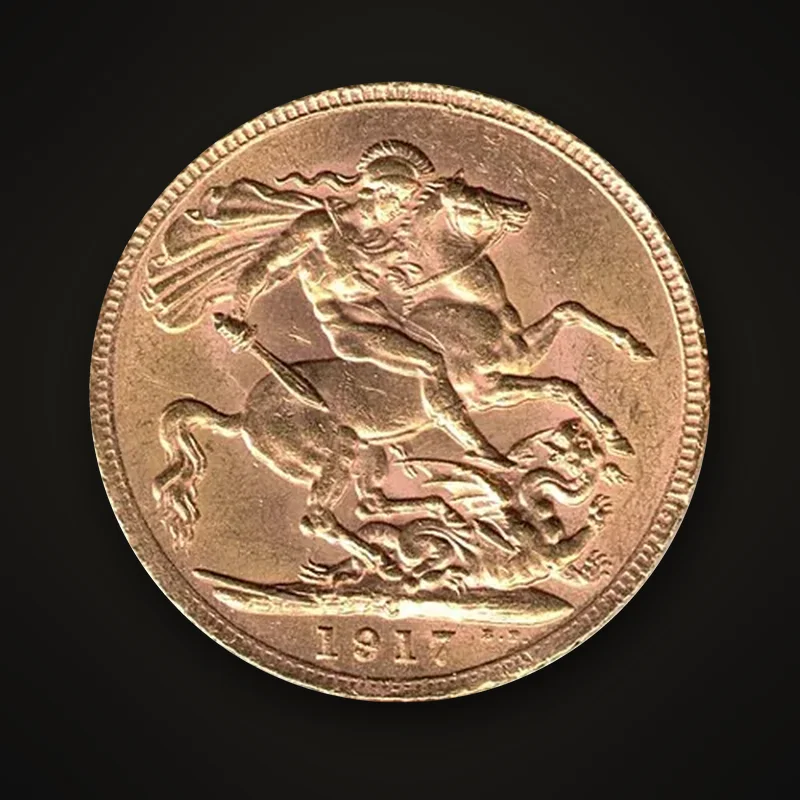
The reverse also helps with dating. Saint George only appears on the half sovereign in 1893, with Victoria's old head, so a young-head Victoria half sovereign always carries the shield. The sovereign shows Saint George from 1817 to 1825 and again since 1871, which leaves a long stretch when both reverses coexist depending on the mint.
The rare dates differ too. The 1821 half sovereign, withdrawn because it looked too much like a gilded silver sixpence, and the Perth half dated 1918 have no sovereign equivalent. Conversely, the 1819 sovereign has no half: no half sovereign bears that date. Half sovereigns for circulation end in 1926 at Pretoria, six years before sovereigns.
A coin on both sides of the Channel
The sovereign was born of an 1816 Act that put the United Kingdom on the gold standard and replaced the guinea. Its start was difficult: the British preferred their one-pound notes, and many new coins went to the melting pot. Robert Peel estimated that in 1819 three quarters of the gold used in France came from melted sovereigns.
During the nineteenth century the coin became the reference gold coin well beyond the British Isles, from Portugal to Brazil and throughout the Empire. Sydney, Melbourne and Perth struck so many that by 1900 about four in ten sovereigns circulating in Britain came from Australia.
Circulation stopped in August 1914, when notes replaced gold in British payments. London struck until the end of 1917, then Bombay, Ottawa and Pretoria took over. After 1932 no sovereign was issued as everyday currency. The coin returned in 1957, this time to meet demand for gold in the Middle East, paused from 1969 to 1973, and has been struck without a break since 1974. Other British coins appear in the foreign coins section.
Period copies and modern fakes
Few gold coins have been imitated so much. After 1945 the sovereign remained in strong demand in Greece and the Middle East, and clandestine workshops produced it in Italy, Switzerland, Lebanon and elsewhere. Resuming official striking in 1957 was partly meant to undercut them; a prosecution of counterfeiters had failed when the judge ruled the coin was no longer current.
These fakes raise a particular problem: many are in 22-carat gold and of the right weight. Weighing proves nothing, so look at the design. A fake often gives itself away through soft relief, letters with blurred outlines, the grainy surface of a cast coin or uneven milling. Check consistency as well: a portrait paired with a year when it did not exist, or a mint mark on a date that mint never struck, is enough to condemn a coin.
The half sovereign is copied less often, but the same checks apply. The guide recognising a fake coin sets out the method step by step.
Judging wear on the rider and the portrait
On the reverse, Saint George carries the high points. The horse's mane and head, the rider's leg and helmet flatten first; on a heavily worn coin the animal's muscles become a smooth surface and the dragon loses its scales. On the shield, look at the quarters of the arms, the pearls of the crown and the veins of the laurel leaves.
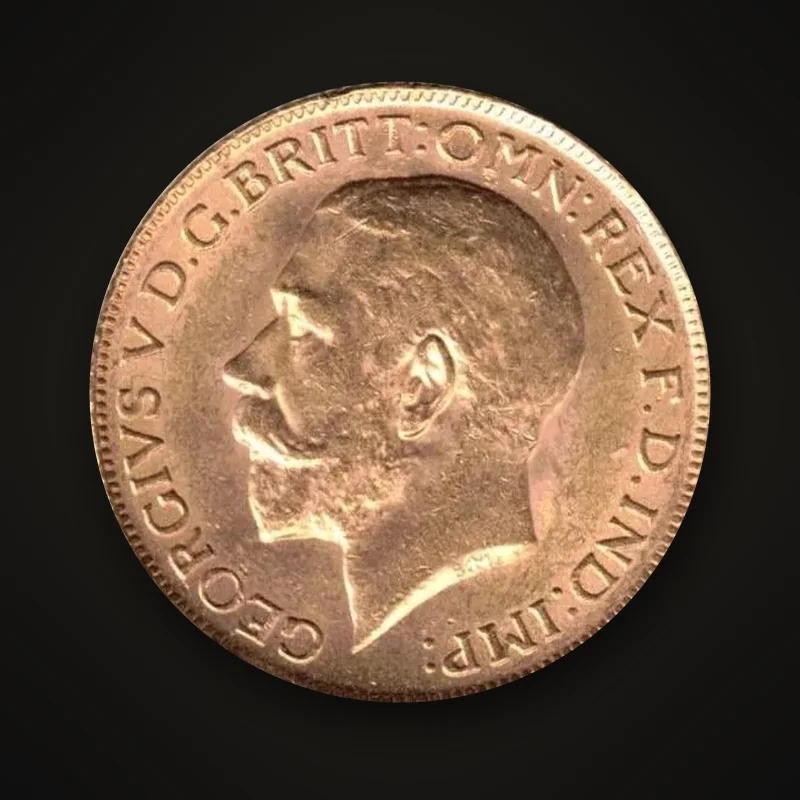
On the obverse, each reign has its fragile areas: George V's beard and ear, Edward VII's cheek and hair, the ribbon tying the young Victoria's hair. On a half sovereign, being smaller, these details vanish sooner and a magnifier becomes essential.
Many sovereigns were mounted as brooches, pendants or rings. A solder mark, a filed loop or a damaged edge shows under a glass. Never rub a coin to make it shine: the guide cleaning a coin explains the damage, and the grading scale is set out in coin grades.