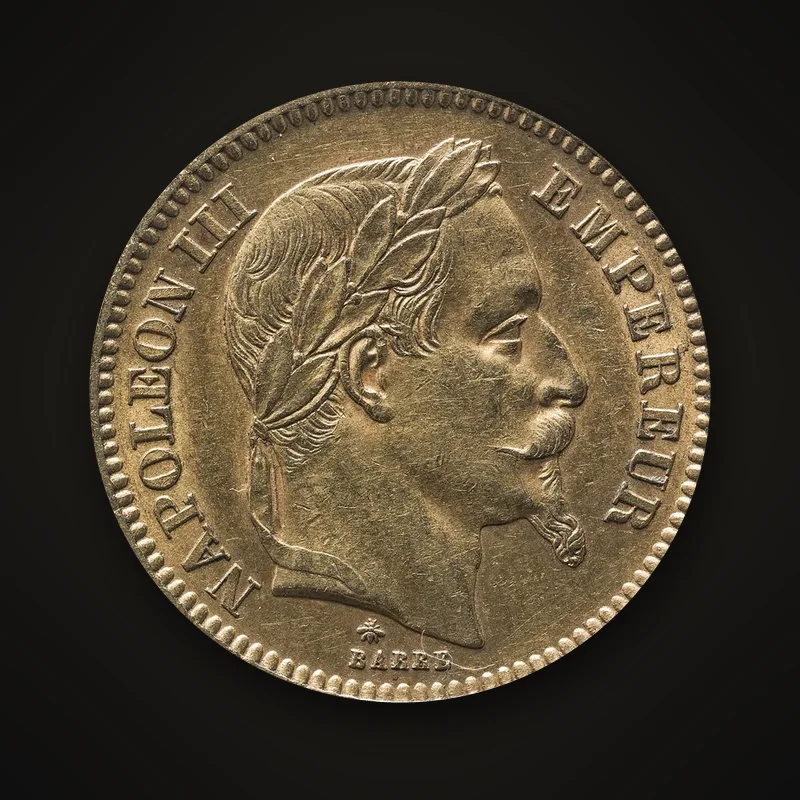
Obverse
Profile of Napoleon III facing right, signed BARRE at the base of the neck. From 1853 to 1860 the head is bare; from 1861 to 1870 it wears a laurel wreath. Circular legend: “NAPOLEON III EMPEREUR”.
Written by the Maison Or & Bijoux Le Havre team · updated
| Country | France |
|---|---|
| Metal | Gold, 900‰ fine |
| Weight | 6.45 g |
| Fine gold | 5.806 g |
| Diameter | 21 mm |
| Years struck | 1853 to 1860 for the bare head, 1861 to 1870 for the laureate head |
| Mints | A (Paris), D (Lyon, 1855 only) and BB (Strasbourg); none struck at Rouen (B) |
| Total mintage | 146,544,669 bare heads; about 85.5 million laureate heads |
| Edge | “DIEU * PROTEGE * LA * FRANCE” in relief |
| References | Le Franc F.531 (bare head) and F.532 (laureate head) |
This is the gold coin most often found in a family box: more than 230 million were struck between 1853 and 1870. An emperor's profile with a moustache and a pointed goatee, and the legend “NAPOLEON III EMPEREUR”: identification takes a few seconds. The numismatist's work begins afterwards, with the date, the mint mark and two tiny symbols on the reverse.
Profile of Napoleon III facing right, signed BARRE at the base of the neck. From 1853 to 1860 the head is bare; from 1861 to 1870 it wears a laurel wreath. Circular legend: “NAPOLEON III EMPEREUR”.
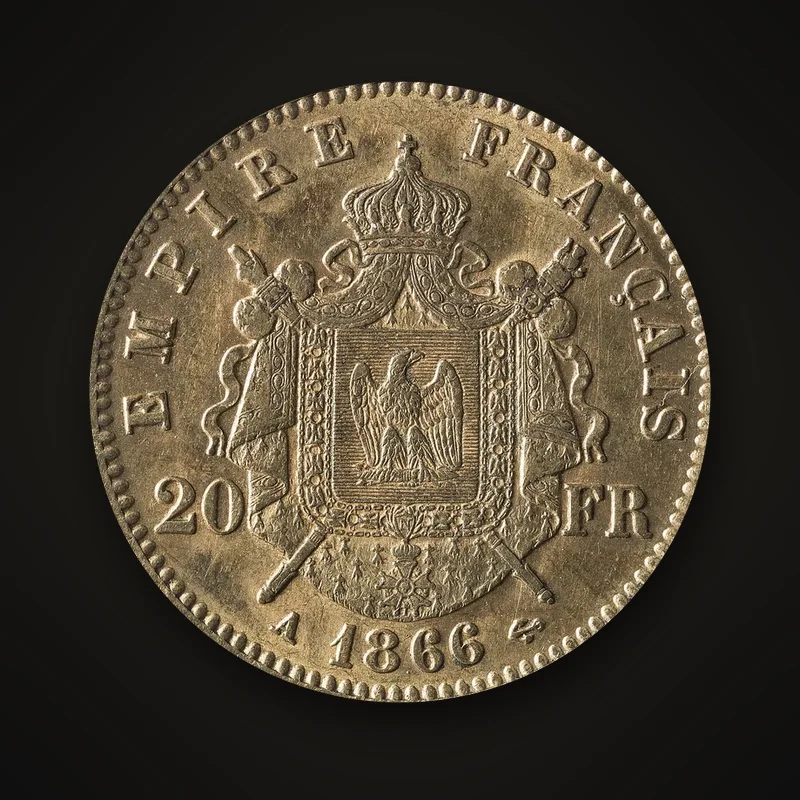
Bare head: a wreath of two laurel branches tied at the bottom, with “20 FRANCS” and the year in the centre; legend “EMPIRE FRANÇAIS”; the mint mark sits below the bow. Laureate head: the imperial arms, that is an eagle on a thunderbolt in a shield encircled by the collar of the Legion of Honour, all set on a mantle topped by a crown; “20” and “FR” flank the shield, and the year and mint mark are at the bottom, below the legend “EMPIRE FRANÇAIS”.
There is no line for Rouen: the letter B does not exist on this type, as the BDOR tables list only A, D and BB. To place your coin, first look for its year and letter in the list. The very large Paris mintages of 1854 to 1859 are the ordinary coins; figures below two million point to the years worth a closer look.
| Year | Mint | Mintage | Remarks |
|---|---|---|---|
| 1853 | A | 5,729,471 | The type appears |
| 1854 | A | 23,485,957 | Most plentiful year of the bare head |
| 1855 | A | 16,595,397 | Privy marks dog's head and hand, or hand and anchor |
| 1855 | BB | 1,759,701 | Privy marks dog's head and bee, or bee and anchor |
| 1855 | D | 363,017 | Lyon, small or large lion; smallest mintage of the bare head |
| 1856 | BB | 1,125,030 | Dog's head or anchor with the bee |
| 1857 | A | 19,193,214 | Paris alone that year |
| 1858 | BB | 2,016,653 | Different figure from CGB, see the note |
| 1859 | A | 20,295,429 | Common |
| 1860 | A | 10,219,917 | Variety with the 6 re-engraved over a 5 |
| 1860 | BB | 5,726,718 | Variety with the 6 re-engraved over a 5 |
| 1861 | A | 2,607,054 | First laureate head |
| 1861 | BB | 1,423,199 | Laureate head, small mintage |
| 1862 | A | 4,825,915 | Normal letter or “large A” |
| 1865 | A | 2,951,440 | Small Paris mintage |
| 1866 | BB | 6,978,507 | A variety with a reeded edge is known |
| 1867 | A | 2,923,024 | Small Paris mintage |
| 1868 | A | 9,281,061 | Most plentiful year of the laureate head |
| 1869 | BB | 7,316,553 | Normal or large letter; figure disputed, see the note |
| 1870 | A | 864,873 | Smallest mintage of the laureate head |
| 1870 | BB | 1,852,567 | Last year of the type |
Figures taken from the BDOR tables, cross-checked with Abacor; varieties according to Le Franc (F.531, F.532). Each line gives the total for the year and mint, all varieties combined. Known discrepancies: CGB gives 2,067,740 for 1858 BB, Numista 1,817,394 for 1855 BB, and CGB attributes 864,873 coins to a variety of 1869 BB. The years missing here have middling mintages, between these extremes.
When several coins arrive together, always work in the same order. Step one: separate the bare heads from the laureate heads. The reverse is enough, a laurel wreath on one, a coat of arms on the other. Step two: read the year, then the mint mark. On the bare head it hides below the bow of the branches; on the laureate head it sits next to the year.
Step three: with a ×10 loupe, find the two small symbols on either side of the date, known as privy marks (“différents”). Step four: put each coin on scales accurate to a hundredth of a gram. Allow 6.45 g for an unworn coin; a coin that has circulated heavily loses a few hundredths, rarely more. Step five: turn the coin between two fingers to read the edge, whose letters should be crisp and even.
At the end you have two piles: the ordinary dates, by far the more numerous, and the coins to show a numismatist, because a letter, a date, a privy mark or a manufacturing detail is out of the ordinary. The same method works for the other gold coins (in French) of the 19th century.
Each coin carries two marks of responsibility. The first identifies the Chief Engraver, who supplied the dies; the second the director of the mint that struck the coin. On the bare head, the dog's head stands for Jacques-Jean Barre and the anchor for his son Albert-Désiré, who succeeded him in 1855. For the directors, Paris used a hand, Lyon a lion and Strasbourg a bee.
This double signature explains the interest of 1855: the change of engraver happened within the year, and two combinations exist side by side for the same date and the same mint. The version with the dog's head is the less often seen.
The letter itself sometimes varies in size. A “large A” is known for 1862, and an enlarged BB for several years of the laureate head. These details can only be seen with a loupe, by comparing with an ordinary coin. For the other letters you will come across on French coins, see the guide to French mints (in French).
Four peculiarities recur in the catalogues. The date 1860 with a 6 cut over a 5 exists from two mints. The 1866 with a reeded edge replaces the edge lettering with reeding, and it is rare. The burnished flans with a plain edge of 1853, 1854 and 1855 were used for official presentations. Finally, patterns of the laureate head are recorded for 1861, 1862 and 1868; they remain in specialist collections.
The Second Empire had its forgers too. They struck coins in platinum, whose density gave a weight close to the correct one. A scratch, a worn relief or a rubbed rim reveals a grey metal beneath the surface. These old pieces now interest collectors of period forgeries.
Recent counterfeits, by contrast, are in gold and sometimes of the correct fineness. They give themselves away through soft relief, a beard and hair lacking finesse, or an edge with letters of uneven height. The basic check remains the same: 6.45 g, 21 mm, a crisp edge. The guide to fake coins (in French) sets out further checks.
A coin that spent years in a purse always wears in the same places. On the bare head, look at the hair just above the ear: well preserved, it shows separate locks; worn, it becomes a flat surface. The cheekbone and the tip of the goatee follow. On the reverse, the veins of the laurel leaves and the loops of the bow disappear before the lettering.
On the laureate head, the leaves of the imperial wreath are the first to lose their veins, then merge into the hair. On the reverse, watch the eagle's feathers and the links of the collar: these fine details give way before the large folds of the mantle.
Most examples kept in families grade between F (French TB) and VF (TTB). An EF (SUP) coin keeps some original lustre in the recesses, around the letters. If yours has some, do not rub it: cleaning leaves fine scratches, visible under a loupe, and a collector will turn away from it. The guide to coin grades describes each grade, and the one on cleaning explains the possible damage (both in French).
The coin's standard goes back to the germinal franc of 1803: 6.45 g of gold at 900 thousandths, as on the 20 francs of Napoleon I (in French). The Empire, restored in December 1852, put the new emperor's portrait on coins the following year. The gold discoveries in California and then in Australia fed the presses: in Paris alone, every year from 1854 to 1859 exceeded sixteen million coins.
In 1861 the profile received a laurel wreath and the reverse adopted the arms of the Empire, from the work of Albert-Désiré Barre. Four years later, France, Belgium, Italy and Switzerland formed the Latin Monetary Union: gold coins of the same weight and fineness from these countries then circulated freely from one to another.
The defeat at Sedan, in September 1870, ended the Empire and the type. The Republic then took up the 20 francs Genius (in French). The imperial napoléons nevertheless went on circulating until 1914, which explains why many of them are worn. The period is covered on the page on 19th-century French coins (in French).
The Rouen mint, letter B, struck no 20 francs of Napoleon III: the mintage tables record only Paris, Lyon in 1855 and a mint in eastern France for this type. Rouen was nevertheless still working. Brought back into use in the 1850s to recoin old copper money, it produced bronze coins marked B, such as the 10 centimes of 1856, before its last strikings in 1857 and its closure in 1858. The napoléons found in Le Havre and elsewhere in Normandy therefore come from other mints, mostly Paris. The history of the Norman mint is told on the page on the Rouen mint (in French).
Not on this type. None of the lists consulted records a 20 francs Napoleon III struck at Rouen. Look with a loupe: it is often a misread BB or a blurred A. If the B is confirmed, the coin should be examined closely.
They are the privy marks: one indicates the Chief Engraver (dog's head or anchor on the bare head), the other the director of the mint (hand for Paris, lion for Lyon, bee for Strasbourg). They tell apart two coins of the same date and the same mint.
A coin that circulated for decades loses a little metal through rubbing. A few hundredths less is normal. A larger difference, or a higher weight, calls for a closer check.
The 1870 Paris mintage (864,873 coins) is the lowest of the laureate head, because striking stopped with the fall of the Empire. The condition of the coin counts as much as the date; a numismatist can examine it during a free valuation.