Liberty or Saint-Gaudens: sorting in seconds
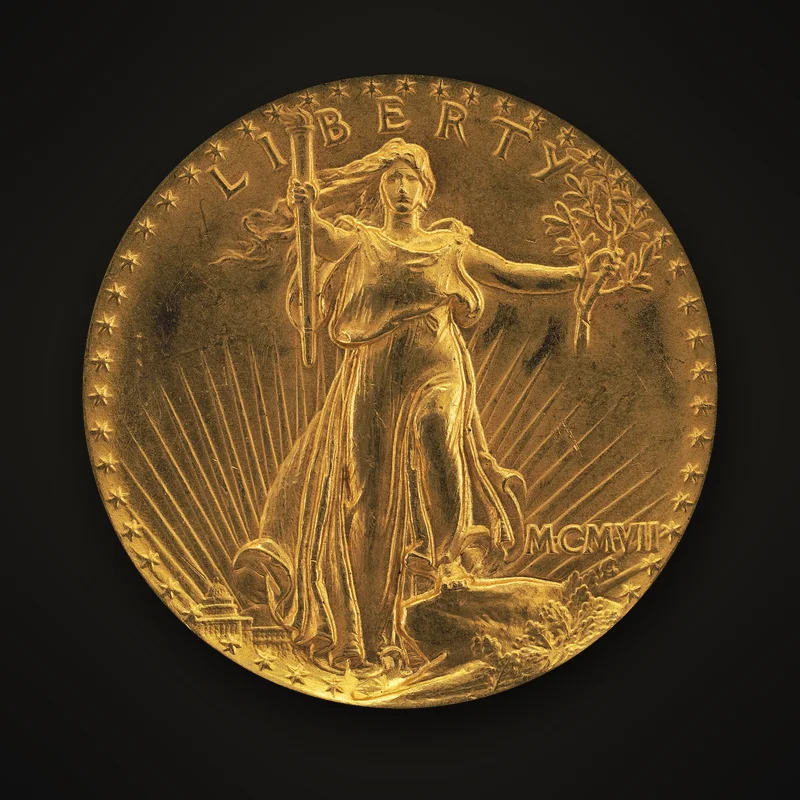
The first sort is made on the obverse. A profile head with a coronet: it is a Liberty, struck from 1850 to 1907. A full-length woman walking towards you: it is a Saint-Gaudens, from 1907 to 1933. The edge confirms it: reeding for the first, raised lettering for the second.
The Liberty then divides according to the reverse. With no motto above the eagle and “TWENTY D.”, it is Type I (1850-1866). With “IN GOD WE TRUST” but still “TWENTY D.”, Type II (1866-1876). With “TWENTY DOLLARS” written in full, Type III (1877-1907), by far the most frequent.
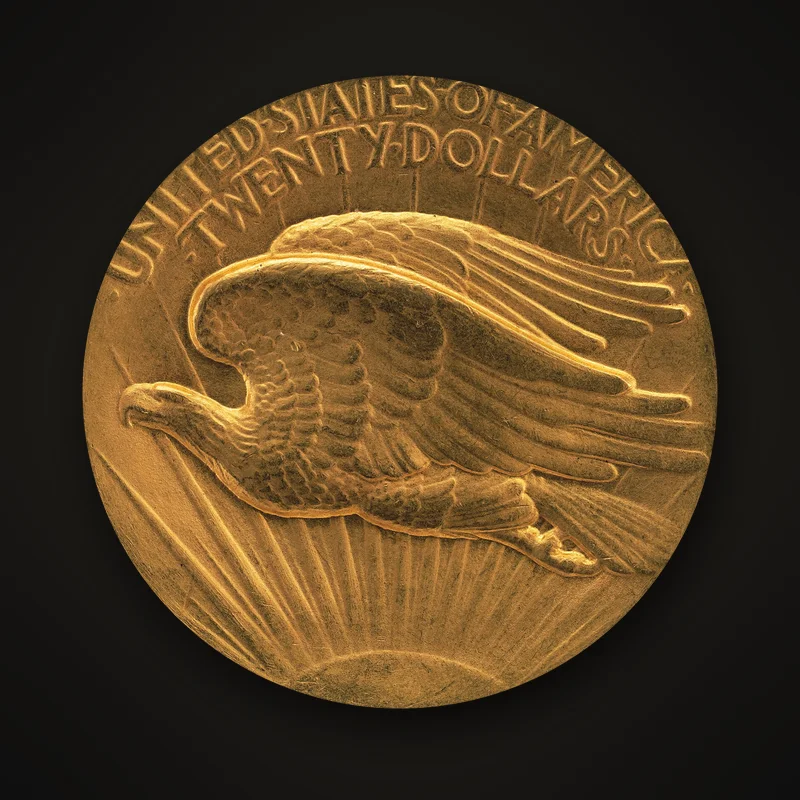
For the Saint-Gaudens, look at the date and the reverse. A date in Roman numerals, MCMVII, marks the 1907 high relief, with very deep modelling. An Arabic date with no motto on the reverse points to the strikings of late 1907 and early 1908. After that the motto is always there, and the two extra stars of 1912 mark New Mexico and Arizona joining the Union.
From America to European vaults
The $20 coin was born of the gold rush: the Act of 3 March 1849 created both the gold dollar and this large coin, double the $10 eagle. The mints of San Francisco, New Orleans and Carson City, close to the mines, joined Philadelphia.
From the 1880s the coin became an instrument of international payment. Millions left for Europe in cloth bags of 250 coins. Many were melted there: those sent to the United Kingdom often ended up turned into sovereigns. Some, however, lay dormant in bank strongrooms.
In 1933 Franklin Roosevelt suspended gold payments on 6 March, then on 28 December Americans were ordered to hand in their coins to the Treasury. Those still in the United States were melted by the million. The coins kept in Europe escaped the furnace and came back onto the market from the 1940s. That is why the 1924 Philadelphia coin, long thought difficult, is today one of the commonest. See also gold coins.
Fakes, copies and modern coins to rule out
The $20 coin has been counterfeited on a large scale, above all in the 1960s and 1970s to satisfy demand for gold in the Middle East. These pieces are often gold, sometimes at the exact weight, so the scales do not settle the matter. The clues lie elsewhere: puffy, indistinct relief, mushy engraver's initials and date figures, small bubbles or pits in the field, too bright a lustre, a metal colour that does not match. On a rare date, an added or erased mint mark is a classic trap. The guide recognising a fake coin sets out these checks.
Other coins cause confusion without being fakes. The $10 gold eagle weighs half as much and measures about 27 mm. The American Gold Eagle struck since 1986 reuses Saint-Gaudens' Liberty, but with a family of eagles on the reverse and a one-ounce marking: it is covered on the modern gold and silver ounces page. The 2009 ultra high relief $20, dated MMIX, is a collector issue in pure gold. Then there are gilded souvenir copies, far too light.
Wear and bag marks
On a Liberty, wear starts with the hair above the forehead and the ear, then reaches the coronet, whose “LIBERTY” letters fade from the top. On the reverse, the eagle's head, neck and wing tips lose their feathers first.
On a Saint-Gaudens, check Liberty's breast and left knee, her face, then the torch. The tiny Capitol blurs at the first rubbing. On the reverse, look at the feathers of the eagle's wing and body.
Most coins found in Europe saw little circulation, but they travelled and slept in bags of 250. They therefore carry contact marks: small nicks in the field, knocks on the rim. For a collector these marks weigh as much as wear. Never try to soften them: the guide cleaning a coin explains why, and the guide coin grades presents the scale used.