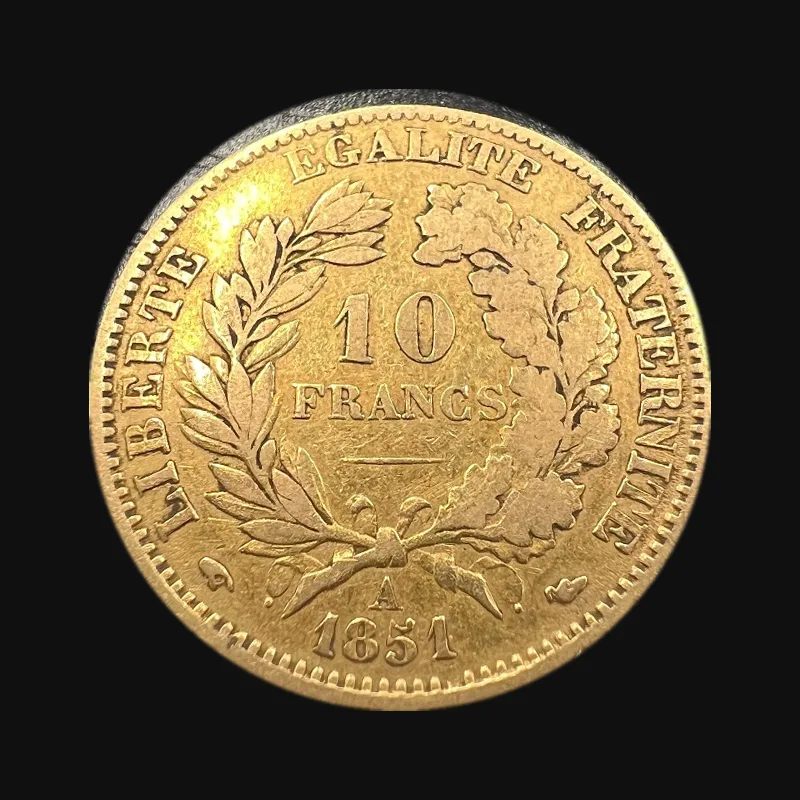
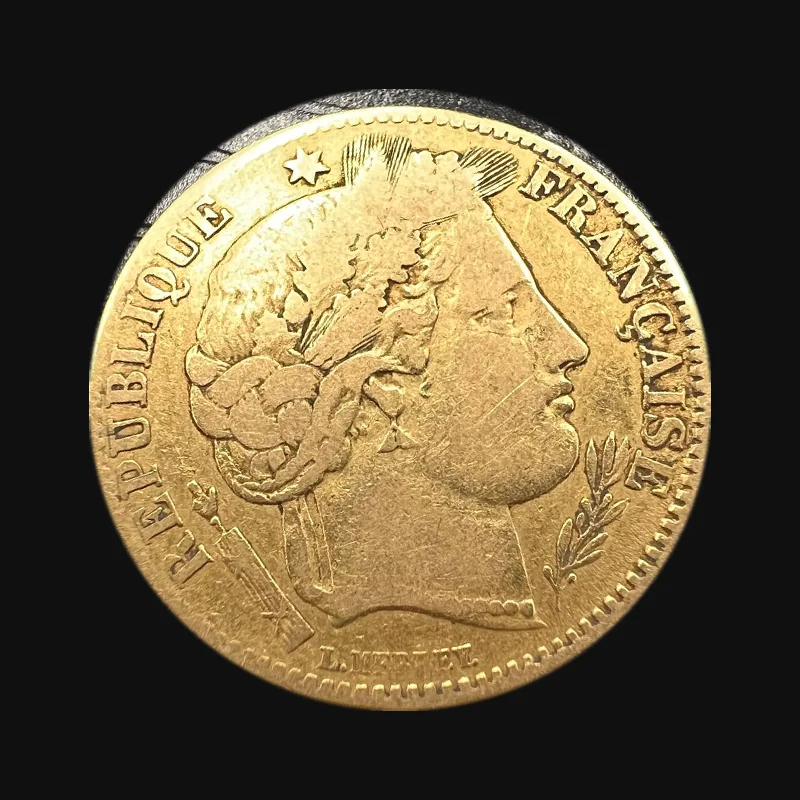
1850: Californian gold and the birth of the 10 francs
The Californian gold rush, from 1848 onwards, flooded Europe with yellow metal. In France, the 1803 system had until then included only 20 and 40 francs in gold. In 1850, the Second Republic created a more modest denomination, the 10 francs, better suited to everyday spending, with Louis Merley's Ceres.
The Second Empire turned the 10 francs into a mass-produced coin: the Paris and Strasbourg mints delivered more than 90 million coins in all, some sixty million of them for the 19 mm bare head alone. The Third Republic was more sparing with the Ceres, about 2.4 million coins from 1878 to 1899, then adopted Chaplain's Rooster, struck until 1914. The war ended the circulation of gold, and France would never again issue a circulating gold 10 francs. The pages on 19th-century French coins and on the Third Republic (in French) put these types in their period.
Four types, three questions
Who is on the coin? A bearded man means Napoleon III; a woman crowned with wheat ears, Ceres; a woman in a Phrygian cap, Marianne, with a rooster on the reverse.
Is the emperor wearing a laurel wreath? Without laurel, it is the bare head of 1854-1860, in the small module of about 17 mm (1854-1855) or in the large module of 19 mm, thinner for the same weight; both formats exist in 1855. With laurel, it is the laureate head of 1862-1868, a hybrid version of which, dated 1862, carries a smaller “10” on the reverse.
What is the date? For Ceres, it alone separates the Second Republic (1850-1851) from the Third (1878-1899). For the Rooster, a reduced version of the 20 francs Rooster, it runs from 1899 to 1914. No date, on the other hand, matches a gold 10 francs with the Genius, a type reserved for the 20, 50 and 100 francs.
Weigh before you look
A scale accurate to the hundredth is the most useful tool for a gold 10 francs. Even worn, a real coin loses only a few hundredths of its 3.22 g; a bigger shortfall, or a thickness that does not fit the 19 mm diameter, points to a coin that needs examining. Next comes the loupe, to judge the drawing of the reeding and the precision of the hair, then the guide to spotting a fake coin (in French).
Weighing also helps to sort a family batch. A gold 20 francs weighs 6.45 g, a Napoleon III gold 5 francs about 1.61 g: the three denominations cannot be confused on the pan. Finally, beware of small gilt tokens and medals that imitate the official types without a face value or date.
Varieties and exceptional dates
The 1855 BB, a large module struck in Strasbourg in about 32,000 examples, is the key date. Far behind it come the 1895 Ceres and the 1909 Rooster. The burnished flans of 1878 (30 coins) and 1889 (100 coins) were prepared for the Paris World Fairs and have nothing to do with circulation.
A few varieties can be read under a loupe: in 1854, plain edge with a large or small A, then reeded; in 1850, Ceres with “oreille relevée” (raised ear) or “oreille basse” (low ear); from 1863 to 1866, small and large BB on the laureate heads; in 1860, in Paris, several shapes of the 6 and a bee privy mark; in 1899 and 1900, Roosters on matt flans.
Wear and damage on 19 mm
The reliefs of a gold 10 francs are fine, and a few years in circulation are enough for an Extremely Fine (SUP) example to drop to Very Fine (TTB). Points to watch: hair above the ear, goatee and laurel veins for Napoleon III; wheat ears and forehead locks for Ceres, where grains that can no longer be read indicate Fine (TB); hair over the forehead, rim of the cap, breast and wing of the rooster for Chaplain's type.
In such narrow fields, a scratch or a knock weighs on the assessment of condition. Holed, soldered coins or coins taken out of a mount have almost no collector interest left. Do not rub yours, and see why not to clean a coin as well as the grading guide (both in French).