Skip to content
Belgium, Italy, Switzerland

Latin Monetary Union gold 20 francs: Belgium, Italy, Switzerland

Belgium, Italy, Switzerland · 1861-1914 · Gold

Written by the Maison Or & Bijoux Le Havre team · updated

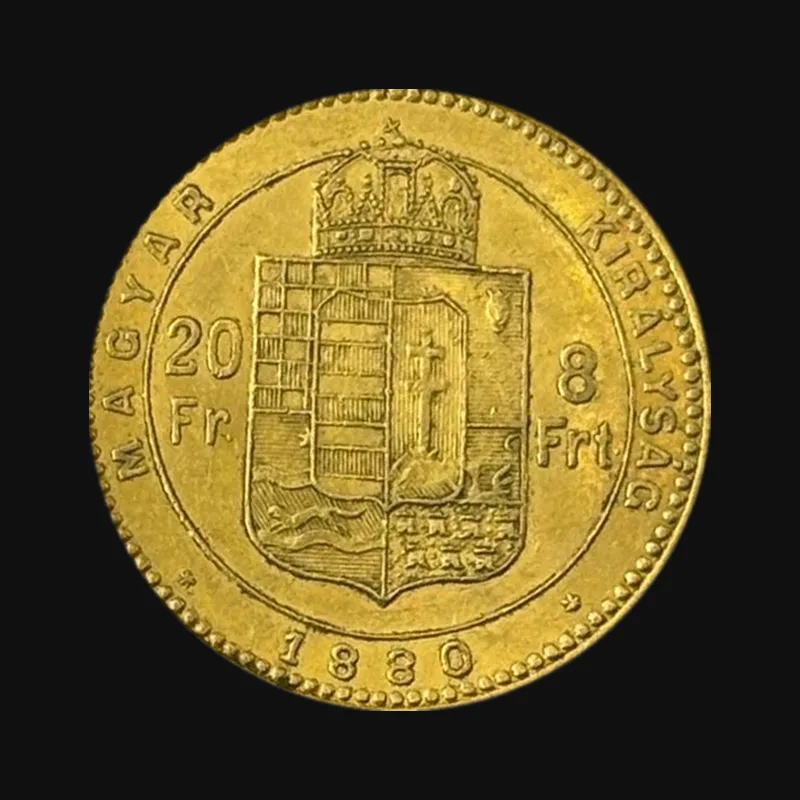
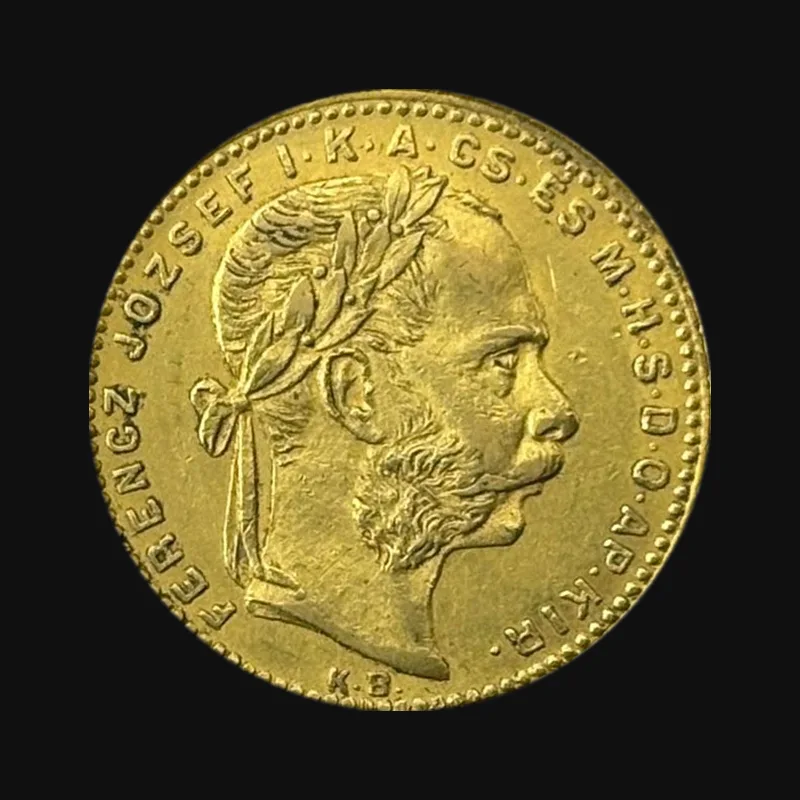
8 forint / 20 francs gold of Franz Joseph, Hungarian issue, obverse8 forint / 20 francs gold dated 1880, reverse with the arms of Hungary
Photos: Maison Or & Bijoux.
Specifications
CountryBelgium, Italy, Switzerland
MetalGold, 900‰ fine (10% copper)
Weight6.45 g (6.4516 g)
Fine gold5.806 g
Diameter21 mm
Years struckItaly 1861-1897, Belgium 1865-1882 and 1914, Switzerland 1883-1896 for the Helvetia
MintsTurin (T), Milan (M), Rome (R); Brussels; Bern
EngraversFerraris and Speranza; Wiener and Devreese; Walch, Bühler and Schwenzer
EdgeReeded or with a motto
References20 lire 1875 R: Pagani 472 (KM 10.2); Belgian 20 francs 1914: Morin 281, Morin 282

In a box of napoléons, a coin sometimes reads “ROI DES BELGES”, “RE D'ITALIA” or “HELVETICA”. Nothing odd about it: from 1865 to the Great War, Belgium, Italy and Switzerland shared a single monetary system with France, and their gold 20 pieces copied the specifications of the French 20 francs exactly. Weigh it: 6.45 g for 21 mm, of which 5.806 g is pure gold.

Identification

Latin Monetary Union gold 20 francs: Belgium, Italy, Switzerland: how to recognise it

8 forint / 20 francs gold of Franz Joseph, Hungarian issue, obverse

Obverse

Three countries, three effigies. Belgium shows its king in profile to the right, with the signature “L. WIENER”: “LEOPOLD PREMIER” in 1865, “LEOPOLD II ROI DES BELGES” from 1867 to 1882, then Albert I in 1914, either “ALBERT ROI DES BELGES” or “ALBERT KONING DER BELGEN”. Italy turns its kings to the left: “VITTORIO EMANUELE II”, then “UMBERTO I RE D'ITALIA”. Switzerland replaces the ruler with Helvetia, her hair bound by a diadem reading “LIBERTAS”, with the legend “CONFOEDERATIO HELVETICA”.

8 forint / 20 francs gold dated 1880, reverse with the arms of Hungary

Reverse

Belgian pieces: heraldic lion in a shield under a crown, value “20 FRANCS” and date. Italian pieces: Savoy shield under a crown, “L. 20”, mint letter, and the legend “REGNO D'ITALIA” for Victor Emmanuel II. Swiss pieces: cross shield with a star above, wreath of oak and olive leaves, “20 FR” and date.

Edge
In Belgium, the motto DIEU PROTEGE LA BELGIQUE runs around the edge; in Italy, it is reeded. On the Swiss side, 1883 has a reeded edge and the later years the motto DOMINUS PROVIDEBIT, according to most catalogues.
Engraver
The Belgian effigies are the work of Léopold Wiener (Leopold I, Leopold II) and Godefroid Devreese (Albert I). For Italy, Giuseppe Ferraris drew Victor Emmanuel II and Filippo Speranza drew Umberto I. The Helvetia was designed by Albert Walch and Christian Bühler; Karl Schwenzer engraved its dies.
Dates and mintages

Latin Monetary Union gold 20 francs: Belgium, Italy, Switzerland: key dates

The table follows the order of the years. Pieces of Leopold II and Umberto I are the ones that come up most in inheritances. Coins to watch for: the very first Turin 20 lire and the Rome ones under Victor Emmanuel II, Albert I's single date, and above all the Helvetia, whose 1887, 1888, 1893 and 1895 issues run to hundreds or dozens of pieces.

Latin Monetary Union gold 20 francs: Belgium, Italy, Switzerland: dates and mintages
YearCountry and typeMintMintageRemarks
1861Italy, Victor Emmanuel IIT3,267Birth of the Kingdom of Italy.
1865Belgium, Leopold IBrussels1,548,066Part struck in 1866 with this date.
1867Belgium, Leopold II, heavy beardBrussels1,341,307First portrait of the king.
1870Belgium, Leopold IIBrussels3,191,203Frequent.
1873Italy, Victor Emmanuel IIRn/aVery rare Rome date.
1875Italy, Victor Emmanuel IIR51,000Low output.
1877Belgium, Leopold II, fine beardBrussels5,906,070Largest Belgian mintage.
1882Belgium, Leopold IIBrussels522,000Last date of the reign.
1882Italy, Umberto IRn/aMost widespread date.
1883Switzerland, HelvetiaBern250,000Launch year.
1887Switzerland, HelvetiaBern176Great rarity.
1888Switzerland, HelvetiaBern4,224Very few struck.
1893Italy, Umberto IR41,214Fairly rare.
1893Switzerland, Helvetia (Gondo gold)Bern25Punch mark, paler gold.
1895Switzerland, Helvetia (Gondo gold)Bern19Punch mark, paler gold.
1896Switzerland, HelvetiaBern400,000Final year, most plentiful.
1914Belgium, Albert IBrussels125,000Two legends counted together.

Selected dates, not exhaustive. For Belgium, Numisview (1914), StashOfCoins and CoinVarieties, the last two agreeing for 1875, 1876 and 1882. For Italy, CoinVarieties (1875 R), NumisBids (1861 T) and CollectorsKey (1893). For Switzerland, Kettner Edelmetalle and Bdor, in agreement.

Reading a coin in three steps

Start with the obverse and its legend, which tells you the origin: the Belgian kingdom, the Italian kingdom or the Swiss Confederation. The ruler comes next. Leopold II for Belgium and Umberto I for Italy are the rule; Leopold I, Albert I or Victor Emmanuel II, the exception. Finish with the reverse: the date and, on an Italian coin, the letter T, M or R.

Scales and callipers serve as a check rather than a means of identification, since all of them show 6.45 g and 21 mm. A clear discrepancy, on the other hand, signals a problem. To make out a worn date, tilt the coin under a lamp with a magnifier in hand, without rubbing.

Helvetia, the short Swiss series

Before the famous Vreneli, Switzerland struck a first gold 20 francs, from 1883 to 1896, at the Bern mint. Its design is by Albert Walch and Christian Bühler and its dies by Karl Schwenzer. It shows Helvetia in profile, wearing a diadem marked “LIBERTAS”, and on the reverse the federal cross shield under a star, in a wreath of oak and olive.

The series is brief and very uneven. 1883 (250,000 pieces) and 1896 (400,000) are the best-supplied years. By contrast, 1887 produced only 176 pieces and 1888, 4,224. In 1893 and 1895, a small quantity of gold mined at Gondo, in the Valais, gave 25 and then 19 pieces, marked with a tiny punch in the centre of the shield and a lighter tint.

From 1897, the plaited young woman of the Vreneli, set against the Alps, took over with the legend “HELVETIA”. A Swiss 20 francs without mountains is therefore a Helvetia.

Belgian and Italian coins: types and dates

Belgium. The Leopold I type carries only the 1865 date; more than half a million of its coins were in fact struck in 1866. Leopold II followed from 1867 to 1882, first with a bushy, sketchily detailed beard, then with a refined one; 1877 exceeds 5.9 million coins. Catalogues note two positions of the reverse relative to the obverse for some years, and for 1865 a faulty signature, “L. WINNER”. Albert I has a single date, 1914, with a French or Flemish legend, for 125,000 pieces in all.

Italy. Victor Emmanuel II struck in Turin, Milan and then Rome; the first two mints add the initials “BN” of the Banca Nazionale to their letter. The Turin 1861 and Rome 1873 and 1875 dates are rare. Under Umberto I, Rome produced everything; the years 1884, 1889, 1891, 1893 and 1897 are considered rare, and Bdor gives only 9,775 pieces for 1884. Italians call these coins “marenghi”, after the gold 20 francs struck following the victory of Marengo in 1800.

Authenticity and condition

Counterfeiters target the rare Italian dates first, and a large share of the examples in circulation are said to be false. Some contain gold, which makes them misleading on the scales. Check that king, year and mint do not contradict one another (Umberto I struck nothing in Turin or Milan), then examine the edge and the relief of the letters. The guide (in French) reconnaître une fausse pièce goes through these checks.

Wear is judged on the raised parts: Leopold II's beard and hair near the ear, the moustache of the Italian rulers, Helvetia's diadem; on the reverse, the lions of Belgium, the Savoyard cross and its collar, the Swiss foliage. Old jewellery mounts often leave solder or the mark of a bail on the edge. Do not clean your coins: the fine scratches left by a cloth or a product show at once. See the guides (in French) on grades and cleaning.

These coins through time

Their story starts before the Union itself: from the 1860s, Belgium, Switzerland and Italy were striking coins inspired by the franc of Year XI. The Paris convention of 23 December 1865 formalised the alliance with France and committed each country to accept the gold and silver of the others in its public treasuries. Greece joined in 1868; other issuers, such as Austria-Hungary with its 8 florins, Monaco or the kings of Sardinia before 1861, struck to the same module, which keeps the confusion going.

In August 1914, the convertibility of banknotes into gold was suspended and the coins left everyday trade. Belgium left late in 1925 and the Union disappeared on 1 January 1927. Kept ever since by banks and private owners, these coins are common today, apart from the rare dates. To compare them with their French counterparts, open the pages on the Rooster and on Napoleon III.
In Le Havre

Latin Monetary Union gold 20 francs: Belgium, Italy, Switzerland in Normandy

In the 19th century, Le Havre was the favoured port of embarkation for Swiss emigrants leaving for America. The Historical Dictionary of Switzerland counts about 3,000 departures through Le Havre between 1853 and 1859 and nearly 40% of Swiss departures from 1887 to 1938, a period that covers the end of Helvetia striking. The same dictionary notes that Swiss shipowners and merchant bankers took part in Le Havre's trade with America as early as the 18th century. Nothing tells us which coins these travellers carried; but Latin Union gold 20 francs, accepted in France as in the other member countries, turn up today in Norman estates alongside napoléons and sovereigns.

Latin Monetary Union gold 20 francs: Belgium, Italy, Switzerland: frequently asked questions

Were these foreign coins legal tender in France?

Yes. From the 1865 convention, French public treasuries accepted Belgian, Italian and Swiss gold 20 francs on the same footing as French coins, until the 1914 war took gold out of payments.

My Swiss 20 francs has a reeded edge: is that normal?

For a Helvetia dated 1883, yes. For the following years, most catalogues record an edge reading DOMINUS PROVIDEBIT. If the edge does not match the date, have the coin checked.

Which 20 lire do collectors look for?

Above all the Turin 20 lire dated 1861, the Rome dates under Victor Emmanuel II (1873, 1875) and, under Umberto I, 1884, 1889, 1891, 1893 and 1897. They are also the most copied.

What should I do with a Belgian 20 francs that has been holed or set in jewellery?

Do not try to repair it: the gold is still there, but its collecting interest is reduced, and any touch-up would make things worse. A free valuation lets you take stock of the coin as it is.