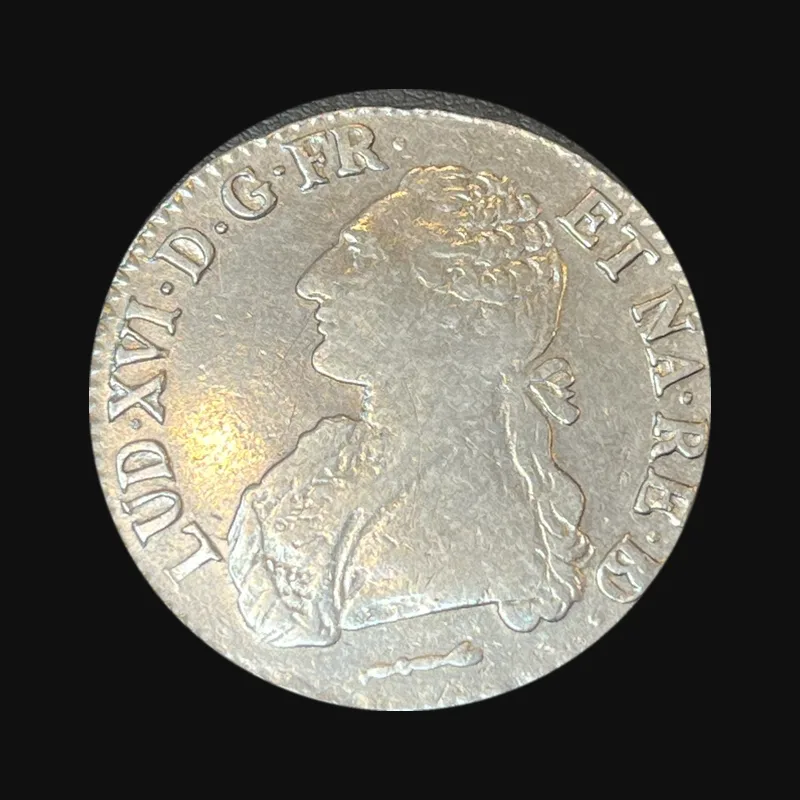
Obverse
The king's effigy with his name and titles in abbreviated Latin. On a Louis XVI écu: “LUD. XVI. D. G. FR. ET NAV. REX”, King of France and Navarre by the grace of God. The last two kings face left, their predecessors mostly right.
Written by the Maison Or & Bijoux Le Havre team · updated
| Country | France |
|---|---|
| Metal | Silver, 917 fine (11 deniers) |
| Statutory weight | 27.45 g at first; 30.59 g from 1709 into the Regency; 29.488 g from 1726 to 1793, after several changes between 1718 and 1725 |
| Diameter | 37 to 41 mm |
| Issued | 1641-1793 |
| Value | 3 livres (1641), then 6 livres (1726) |
| Divisions | Half, quarter, fifth, eighth, tenth, twentieth écu |
| Rouen mint | Letter B |
| Other mints | A (Paris), D (Lyon), K (Bordeaux), T (Nantes), W (Lille), BB (Strasbourg), AA (Metz), 9 (Rennes) and many more |
| Edge | Lettered in the eighteenth century |
| References | Gadoury 217, 229, 317, 322, 356; Droulers; Davenport; KM |
Before the franc, the kingdom's great silver coin was the écu: a piece of about 40 mm and 27 to 30 g, bearing the portrait of Louis XIII, Louis XIV, Louis XV or Louis XVI, issued from 1641 to 1793. A letter on the reverse tells you where it was struck; in Normandy, the B of Rouen is a frequent sight. Together with its half écus and smaller divisions, it is one of the royal coins most often found in inheritances.
The king's effigy with his name and titles in abbreviated Latin. On a Louis XVI écu: “LUD. XVI. D. G. FR. ET NAV. REX”, King of France and Navarre by the grace of God. The last two kings face left, their predecessors mostly right.
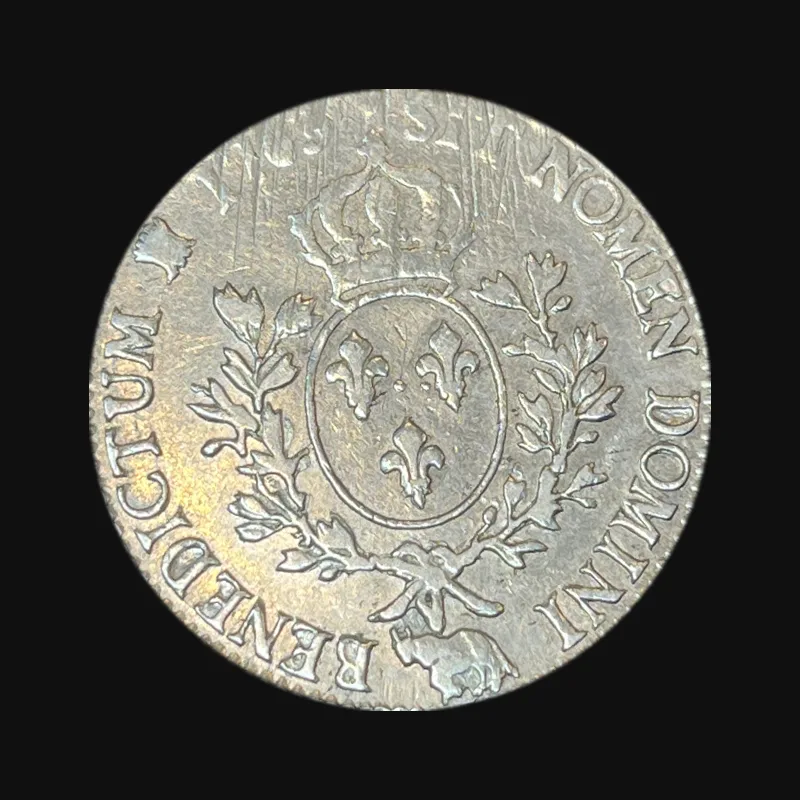
A cross of eight crowned L's or crowns under Louis XIV, then, in the eighteenth century, an oval crowned shield of France set between two olive branches. The legend “SIT NOMEN DOMINI BENEDICTUM” surrounds it with the date; the mint letter, B for Rouen, is placed beneath the shield.
Each row is one type, in chronological order. The Rouen column gives, where our sources provide one, a B-mint striking as an example; “n/a” only means that we have no verified figure, not that Rouen produced nothing. The legal weight remains the first sorting criterion.
| Type | King | Years | Legal weight | Rouen (B) example | Observation |
|---|---|---|---|---|---|
| Écu blanc | Louis XIII | 1641-1643 | 27.45 g | n/a | Warin's engraving, struck on the screw press |
| Short lock, long lock, youthful bust | Louis XIV | c. 1643-1680 | 27.45 g | n/a | Successive portraits of the young king |
| Eight L's, palms | Louis XIV | 1690-1701 | 27.45 g | n/a | Reformations: many écus restruck |
| Three crowns | Louis XIV | 1709-1715 | 30.59 g | n/a | Paris struck 7,335,848 in 1709 |
| Vertugadin | Louis XV | 1715-1718 | 30.59 g | 1716 B: 600,000 | Often on a reformed flan |
| France-Navarre | Louis XV | 1718-1720 | 24.47 g | 1718 B: striking attested | Shield of France and Navarre |
| Olive branches | Louis XV | 1726-1740 | 29.488 g | n/a | The new 6-livre écu |
| Headband | Louis XV | 1740-1770 | 29.488 g | n/a | Metz struck only 78,020 in 1754 |
| Old head | Louis XV | 1770-1774 | 29.488 g | n/a | Final portrait of Louis XV |
| Draped bust | Louis XVI | 1774-1792 | 29.488 g | 1789 B: 235,000 | The 9 of the date is recut over another digit |
| Constitutional | Louis XVI | 1792-1793 | 29.48 g | n/a | Legend “REGNE DE LA LOI” |
Rouen examples: Coinvarieties, 1716-B and 1789-B pages, after the Droulers reference; 1718 B écu from a CGB listing. Other weights and mintages: Coinvarieties (Droulers, Davenport, Gadoury), cross-checked with Wikipedia. Issues of 1720 to 1725 are not detailed.
Turn the écu over. On eighteenth-century types, the mint letter sits at the bottom of the reverse, beneath the crowned shield; on eight-L écus, it occupies the centre of the cross. A single B stands for Rouen. Do not confuse it with BB, the Strasbourg mark, or with AA, that of Metz.
Rouen struck the écu under several reigns. The Droulers reference credits it, for example, with 600,000 vertugadin écus dated 1716, often struck over older coins, and 235,000 Louis XVI écus dated 1789, whose date shows a 9 recut over another digit. The Rouen mint page tells the story of this workshop.
The écu was born of Louis XIII's reform: in 1640 the gold louis replaced the gold écu, and the following year a large 3-livre silver coin, the écu blanc, completed the system. The screw press installed at the Paris mint produced well-rounded coins.
Louis XIV's wars were costly. From 1690 to 1709, the crown had écus brought back to the mints to be restruck with a new type, while their value in livres rose: 3 livres 6 sols in 1689, 5 livres in 1709. After the king's death, John Law's system brought a series of changes in weight and rate.
In 1726, Cardinal Fleury's government fixed the écu at 29.488 g for 6 livres. It never moved again: highly regarded, it circulated as far as southern Germany and Switzerland. The last issue, the constitutional écu, dates from 1793; the 5-franc piece later took over.
The restruck écus of 1690 to 1718 are the great curiosity of the series: beneath the design, part of the previous legend or portrait sometimes shows. Catalogues separate these reformed pieces from strikes on new flans.
Within the same year, privy marks, small signs of the director and engraver, create varieties. The constitutional écu from the BB mint departs from all the others by spelling “FRANÇAIS” instead of “FRANÇOIS”.
Old forgeries, cast or merely silvered, are light, grainy-looking, with blurred edge letters. Recent reproductions prefer sought-after types; soft relief, a dull ring and an inaccurate diameter give them away.
The half écu carries exactly the same design as the écu: only the size changes, under Louis XVI roughly 14.7 g, with a diameter of 30.5 to 33 mm. The lower fractions look even more alike; scales tell them apart.
In the nineteenth century, the word écu referred to the silver 5-franc piece of 25 g. Rouen struck it from year 12 to 1844, with the same letter B: its French legend and its date set it apart beyond doubt.
Before 1640, the name belonged to a gold piece with a sun and no royal effigy: the écu au soleil. As for olive-branch écus bearing a Bern countermark, they are French écus that passed through Switzerland, where they were called Laubtaler.
The hair above the ear, the ribbon, the cheek and the shoulder flatten first. On Louis XVI, the embroidery of the coat is a good indicator: once it can no longer be read, the coin has circulated a great deal.
On the reverse, follow the crown topping the shield and its pearls, then the olive leaves. Relief melted into a smooth mass signals long circulation.
Plenty of écus were drilled for wearing, or polished to bring back the shine. Rubbing leaves fine streaks and an artificial white; an even toning is preferable. Keep the coin uncleaned and bring it in for a free valuation.
For an écu found in Le Havre or the Pays de Caux, the letter to look for is the B of Rouen, the province's mint. It appears for example on the 1716 vertugadin écu, struck in 600,000 pieces according to the Droulers reference, on the 1718 France-Navarre écu and on the 1789 Louis XVI écu, with 235,000 pieces. The mint was still working on the eve of the Revolution. Écus from other mints circulated just as much in Normandy and turn up in the same estates. The history of this mint is told on the Rouen mint page.
Yes, if the letter stands alone. A double B (BB) means Strasbourg. On an eighteenth-century écu, the letter is under the shield, on the reverse.
Because many vertugadin écus were struck over older écus brought back to the mints. It is not a fake: catalogues speak of a reformed flan.
Look at the legend and the date. The royal écu has a Latin legend and a date before 1794; the 25 g 5-franc piece is in French and dates from the nineteenth century.
No. Cleaning leaves scratches and an artificial shine that lower the coin's grade. Collectors appreciate an even toning; show it as it is.