Start by weighing
Put the louis on a scale reading to a hundredth of a gram. Three figures come up most often, and each points to a period.
- About 6.75 g: from the creation of the louis in 1640 until 1709, under Louis XIII and Louis XIV.
- 8.158 g: the sun louis (1709-1715), then every louis struck from 1726 to 1785, under an edict of January 1726.
- 7.649 g: the square-shield louis, after the 1785 reform.
Between 1716 and 1725, the Regency and John Law's system blur the picture: 12.235 g for the Noailles louis, around 9.79 g for the two Ls and the Holy Spirit cross, 6.525 g for the mirliton.
A louis clearly too light for its type is not necessarily false. It may have been clipped, worn, or holed and plugged: only a careful examination will tell. The screw press, used from 1640, gave regular blanks, which makes clipping easier to see.
Portrait and reverse, to narrow it down
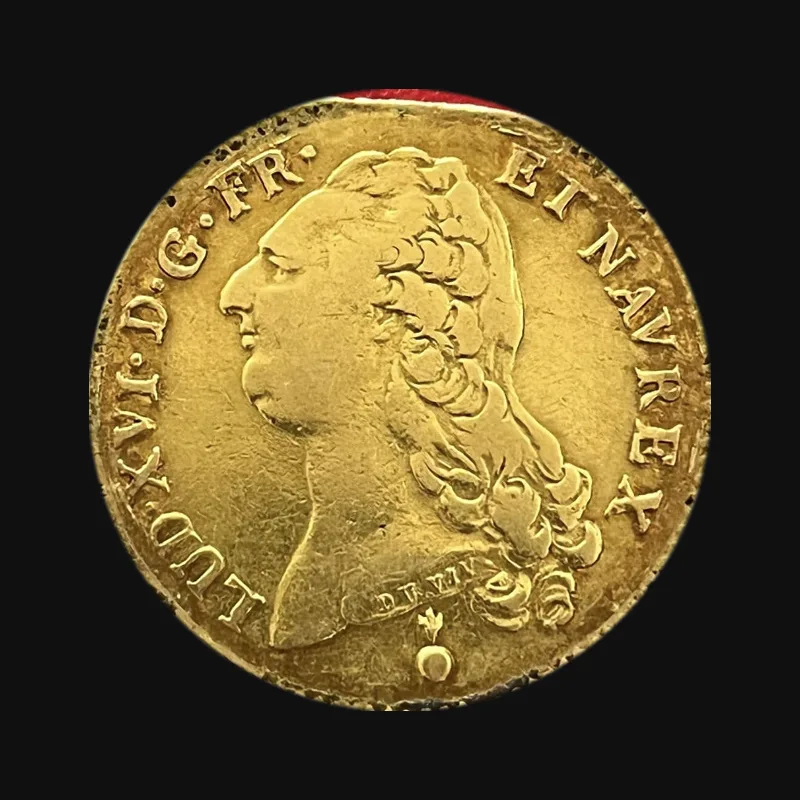
Once the period is known, the portrait names the king. Profile to the right: Louis XIII or Louis XIV. Profile to the left: Louis XV or Louis XVI. The number after LVD removes any doubt.
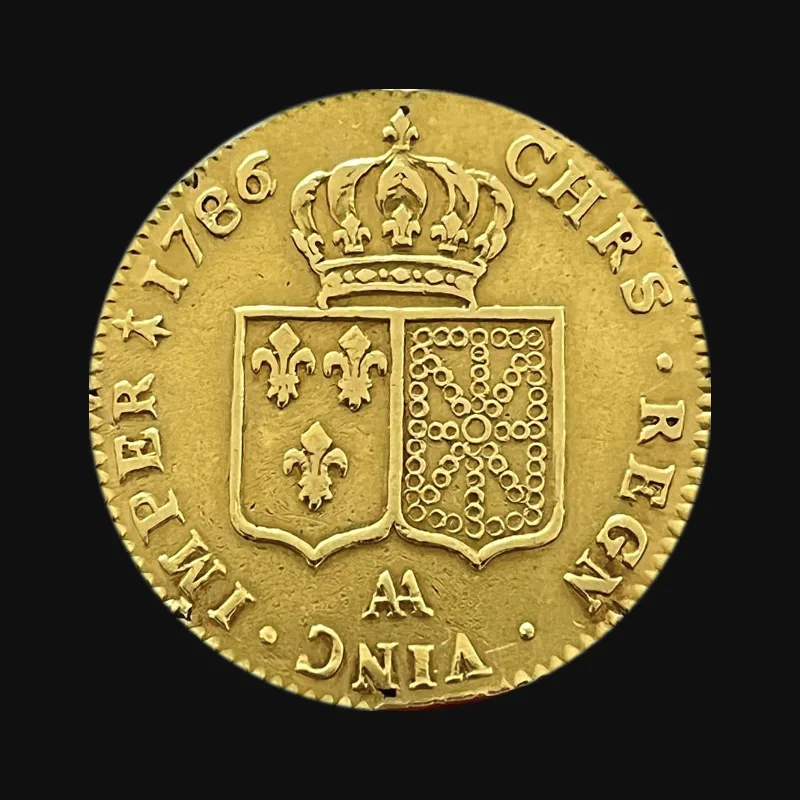
The reverse pins down the type. The cross of crowned Ls dominates under Louis XIII and Louis XIV, with a sun at its centre from 1709. The two oval shields of the “spectacles” louis appear in 1726. Square shields side by side mark a louis of 1785 or later.
The mint letter, and the B of Rouen
The mint letter shows the town where the coin was struck. Depending on the type, it is read below the bust, at the heart of the cross or below the shields. The most common: A for Paris, D for Lyon, K for Bordeaux, T for Nantes, W for Lille, & for Aix.
In Normandy, the letter to know is the B of Rouen. The Rouen mint was still striking louis under Louis XVI: Coinvarieties, after Frédéric Droulers's repertory, counts 418,848 bare-head louis dated 1786 B. For the history of this mint, see our page on the Rouen mint.
Half louis, double louis, mounts and copies
One design, three sizes. The half louis is half the weight of a louis of the same period (3.376 g before 1709, then about 4.08 g under the sun, spectacles and headband types) and measures around 20 mm. Not every series had its double louis: Numista records it for Louis XIII, four Louis XIV types, three of Louis XV and both of Louis XVI; the square-shield double is about 28 mm across. The 4, 8 and 10 louis struck in Paris in 1640 remained ceremonial pieces.
Many louis were turned into brooches or pendants. A removed loop, solder on the edge or a plugged hole clearly reduces their interest to a collector. Keep the coin as it is, without repairs.
Lastly, there are copies in base gold or simply gilt. Weight to the hundredth, diameter and the fineness of the lettering are the first checks. Traces of an earlier design beneath the type, common in the 1690s, come instead from the réformations, when the mints restruck existing louis.
What wear reveals
The highest relief wears first: above the ear, on the laurel or headband, on the cheek. With Louis XV and Louis XVI, the hair loses its locks before the face flattens.
On the reverse, count the pearls of the crowns over the Ls or shields: distinct, the coin has seen little use; merged, it has circulated a lot. The lilies on the shields lose their crispness too.
Avoid any cleaning, which leaves marks and lowers the grade. To have your coin looked at, see our coin valuation page.