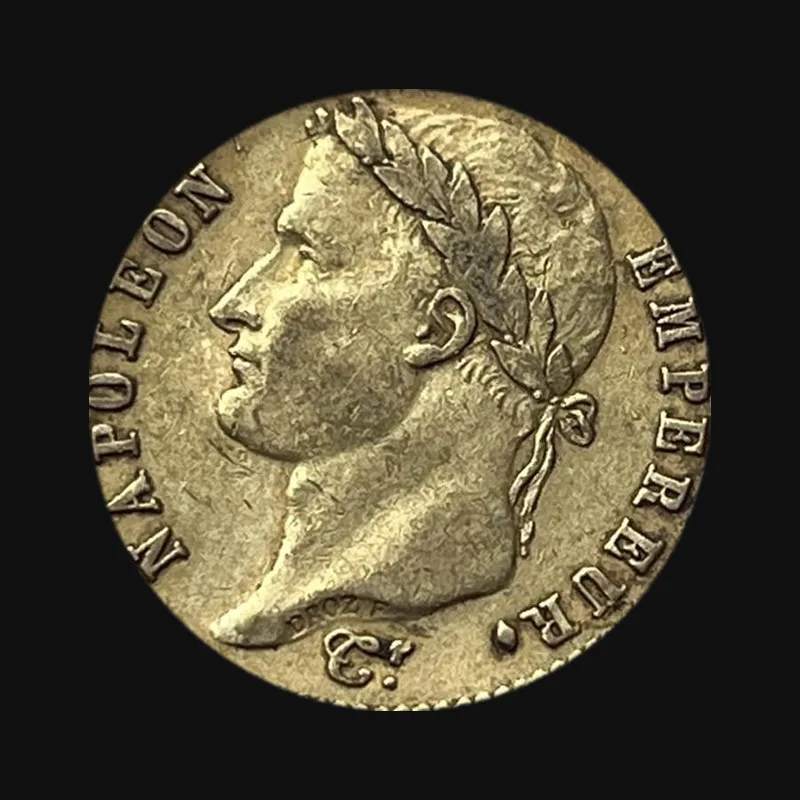
Obverse
Head in profile turned to the left, bare, then laureate from 1807. Two possible legends: “BONAPARTE PREMIER CONSUL” for the Consulate, “NAPOLEON EMPEREUR” from Year 12.
Written by the Maison Or & Bijoux Le Havre team · updated
| Country | France |
|---|---|
| Metal | Gold, 900‰ fine |
| Weight | 6.45 g |
| Fine gold | 5.806 g |
| Diameter | 21 mm |
| Years struck | Year XI to 1815 |
| Types | First Consul; Emperor Year 12; bare head Years 13-14, 1806 and 1807; laureate head with Republic then Empire reverse (seven types in all) |
| Mints | Paris A; La Rochelle H; Limoges I; Bordeaux K; Bayonne L; Toulouse M; Perpignan Q; Nantes T; Lille W; Turin U; Genoa CL; Rome crowned R; Utrecht mast |
| Mintage of the Empire type | 1809-1814: 13,833,717; Hundred Days: 463,682 |
| Engraver | Tiolier for Years XI to 12, Droz from Year 13 to 1815 |
| Edge | “DIEU PROTEGE LA FRANCE” |
| References | F.510-F.516A (Le Franc); G.1020, G.1025 (Gadoury); KM 651, 674 and 695 |
Created by the monetary law of Germinal Year XI, in the spring of 1803, this 20 francs is the oldest of the franc's gold coins. The portrait of Bonaparte as First Consul soon gives way to that of the Emperor, bare-headed at first, then laureate, and the date moves from the revolutionary calendar to the Gregorian one. Some 20 million pieces were struck, mostly in Paris, with tiny runs in certain provincial mints.
Head in profile turned to the left, bare, then laureate from 1807. Two possible legends: “BONAPARTE PREMIER CONSUL” for the Consulate, “NAPOLEON EMPEREUR” from Year 12.
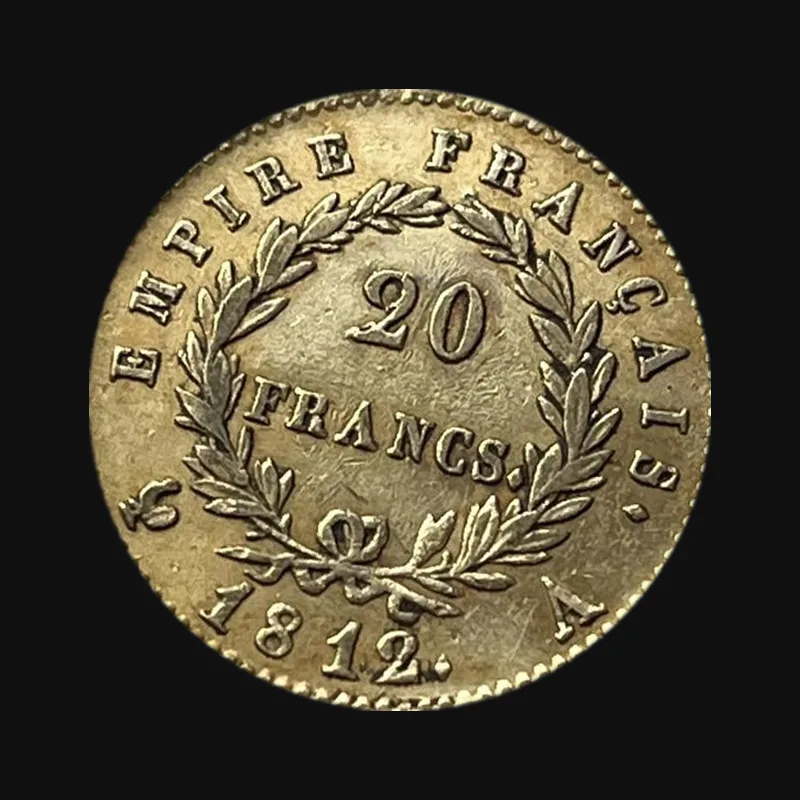
The date and the words “20 FRANCS” are set inside a wreath, above the mint letter. The surrounding legend is republican (“REPUBLIQUE FRANÇAISE”) until 1808; it becomes “EMPIRE FRANÇAIS” in 1809. Years are written AN XI to AN 14 until 1805, then 1806, 1807 and so on.
This table mixes the large Paris outputs, which you meet most often, with the confidential runs of provincial mints, several of them Atlantic ports such as La Rochelle, Nantes and Bordeaux. On a coin marked with a letter other than A, the year matters as much as the letter: some combinations produced only a few hundred pieces.
| Year | Mint | Mintage | Remarks |
|---|---|---|---|
| Year XI | A | 58,262 | Only Year XI date, low mintage |
| Year 12 | A | 988,244 | Consulate |
| Year 12 | A | 428,143 | Tiolier's intermediate bust |
| Year 13 | A | 518,871 | Droz's bare head |
| Year 13 | Q | 522 | Perpignan |
| Year 13 | T | 918 | Nantes |
| Year 14 | A | 148,308 | End of the revolutionary calendar |
| 1806 | A | 963,896 | First Gregorian date |
| 1807 | A | 244,476 | Laureate head, Republic reverse |
| 1808 | A | 1,449,781 | Republic reverse, last year |
| 1808 | K | 281 | Bordeaux, among the lowest mintages |
| 1809 | A | 688,252 | Empire reverse, first year |
| 1809 | H | 501 | La Rochelle |
| 1811 | A | 3,705,489 | Biggest year |
| 1812 | A | 3,072,365 | Frequent |
| 1813 | A | 2,798,409 | Frequent |
| 1813 | Mast | 90,183 | Utrecht |
| 1814 | A | 327,603 | Before the departure for Elba |
| 1815 | L | 18,332 | Hundred Days, Bayonne |
Mintages come from the BDOR tables, compiled type by type; the years and mints listed appear in the Le Franc list (F.510 to F.516A); totals per type were compared with Wikipedia. Coinvarieties publishes a few close but not identical values, such as 1806 A, at 962,929, and 1811 A, at 3,702,681. An extract only: the laureate head with Empire reverse alone gathers 42 year and mint pairs.
Scales accurate to a hundredth of a gram and a calliper give a first sort. The First Empire 20 francs weighs 6.45 g for 21 mm, in gold at 900 thousandths, that is 5.806 g of pure gold. The same weight applies to every 20 francs gold coin until 1914, so on its own it cannot tell a Napoleon I from a Napoleon III. It mainly serves to rule out a copy that is too light or too heavy, and to spot a 40 francs (12.90 g, 26 mm) filed by mistake with the 20 francs.
Then look at the edge: the words “DIEU PROTEGE LA FRANCE” should be even, well spaced, free of burrs. Uneven or poorly aligned letters should raise doubts.
Changes of design follow political history. Under the Consulate, in Year XI and Year 12, Tiolier engraved Bonaparte First Consul. The Empire, proclaimed in Year 12, brought the legend “NAPOLEON EMPEREUR”, but the reverse kept the mention of the Republic.
With Droz came a bare head dated Year 13, Year 14, then 1806 once the Gregorian calendar was back. The year 1807 saw two portraits: a transitional “big head”, then the first laureate head. Following a decree dated 22 October 1808, coins struck from 1809 carry “EMPIRE FRANÇAIS” on the reverse.
Louis XVIII, who came to the throne after the abdication of 1814, issued 20 francs bearing his own effigy. Back in March 1815, Napoleon restarted his type in Paris, Bayonne and Lille: these Hundred Days coins, 463,682 in all, differ from those of 1809-1814 only by their date.
Paris (A) struck the bulk. Several provincial mints, including the ports of La Rochelle (H), Nantes (T) and Bordeaux (K), delivered only small runs in certain years. To the east and south of the Empire, Turin (U) struck from Year 14; Rome (crowned R), Genoa (CL) and Utrecht (a mast) joined in from 1812 to 1814.
Specialists also record die varieties: a rooster in two sizes in Paris in 1810, a horn-shaped flaw under the laurel on some 1808 coins from Toulouse, wide or narrow figures in Rome, Turin and Lille, the date “18 13” in Utrecht, a 5 re-engraved over a 4 on some Paris 1815 coins, and, for the Year 12 Emperor, medal strike or a missing dot after “FRANÇAISE”. The letters are explained in the guide to mints (in French).
In a family collection, this 20 francs often sits next to other gold coins of the same size. The Napoleon III 20 francs reads “NAPOLEON III EMPEREUR” and bears dates from 1853 to 1870. The Louis XVIII 20 francs, struck in 1814 and 1815, show a clothed bust and a royal legend. The 20 lire of the Kingdom of Italy, in the name of “NAPOLEONE”, have an Italian legend.
The word “louis” is also misleading: many families use it for any 20 francs gold coin, whereas the louis d'or is a coin of the monarchy, struck until 1792.
Wear attacks first the hair above the ear, then the temple and the cheekbone. On the bare head, the locks on the nape fade quickly; on the laureate head, the leaves lose their veins and end up forming a smooth surface. On the reverse, observe the wreath: the number of readable leaves, the sharpness of the bow. The legends, protected by the rim, tell you little.
An old mount gives itself away through solder or a filed area on the rim, generally above the portrait. Avoid any cleaning, which scratches the surface. Two guides complete this advice: grades of condition and cleaning (both in French).
Fakes exist, sometimes in 900‰ gold. A soft portrait, a grainy field or a rare date (Year XI, letter H, K, Q, T or CL) call for close observation: a figure or a letter may have been altered. The detailed method is in our guide devoted to counterfeit coins (in French), and you can also ask for a free coin valuation.
A few months before the Germinal Year XI law, Bonaparte stayed in Le Havre during his visit to Normandy in November 1802, the first tour he made of a province as head of state. According to the historian Thierry Lentz, he then set the port, before its newly appointed chamber of commerce, the goal of diverting to France a share of the entrepôt trade, and tradition credits him with the saying that Paris, Rouen and Le Havre form a single town whose main street is the Seine. The Continental Blockade and British reprisals later prevented the project from being carried through. The 20 francs of this period found in Normandy carry no Norman letter: Rouen's B does not appear among the mints of this type. See also the page on the Rouen mint (in French).
Read the name: the second says “NAPOLEON III EMPEREUR”. The dates help too: Year XI to 1815 for the First Empire, 1853 to 1870 for the Second.
These are the mints of La Rochelle, Bordeaux and Nantes. Their output was very low in some years, for example 281 coins in 1808 in Bordeaux: the coin deserves examination by a numismatist, all the more since a letter may have been retouched.
That year, the transitional “big head” bare head and the first laureate head were struck one after the other. Both still read “REPUBLIQUE FRANÇAISE” on the reverse.
On the reverse, below “20 FRANCS”, inside the wreath. Before 1806, it is written as a revolutionary year: AN XI, AN 12, AN 13 or AN 14.