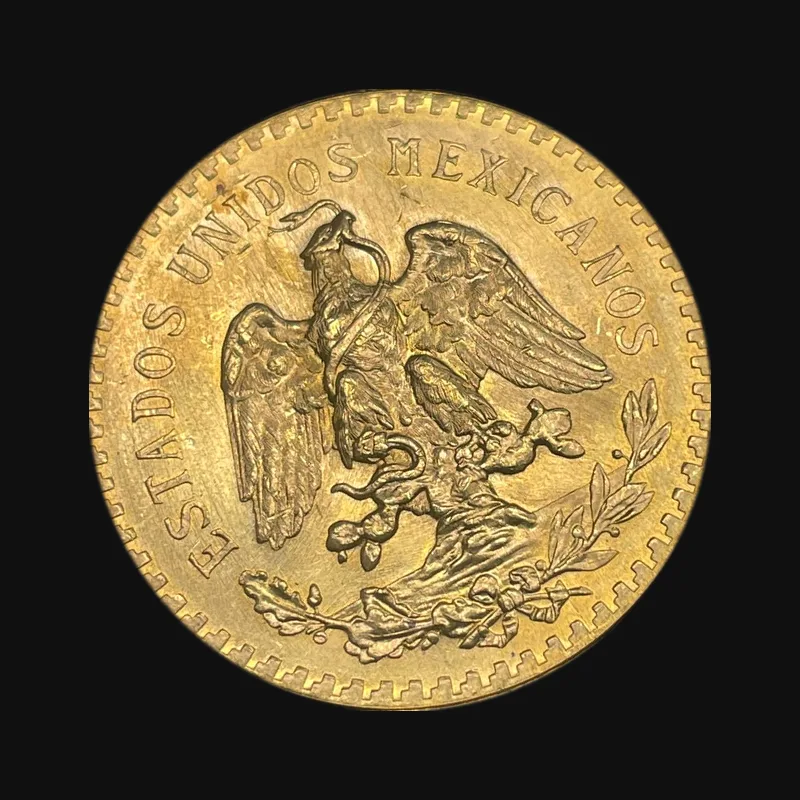
Obverse
The eagle of the Mexican arms, on a cactus, devouring a snake; a laurel branch and an oak branch frame it. Legend: “ESTADOS UNIDOS MEXICANOS”.
Written by the Maison Or & Bijoux Le Havre team · updated
| Country | Mexico |
|---|---|
| Metal | Gold, 900‰ fine (10% copper) |
| Weight | 41.666 g |
| Fine gold | 37.5 g (1.2057 oz) |
| Diameter | 37 mm |
| Thickness | approx. 2.8 mm |
| Face value | 50 pesos (absent from the 1943 type) |
| Years struck | 1921-1931; 1943-1947; later restrikes dated 1947 |
| Mint | Mexico City |
| Krause numbers | KM# 481; KM# 482 (1943) |
Weighing 41.666 g, of which 37.5 g is pure gold, the Mexican 50 pesos coin came into being in 1921 for the centenary of the country's independence, hence its name, Centenario. Few people hold one for the first time without being struck by its size: 37 mm, more than an ounce. Almost all pieces carry the date 1947, kept on official restrikes for decades. The genuine pre-war dates, and the curious 1943 type, are far less widespread.
The eagle of the Mexican arms, on a cactus, devouring a snake; a laurel branch and an oak branch frame it. Legend: “ESTADOS UNIDOS MEXICANOS”.
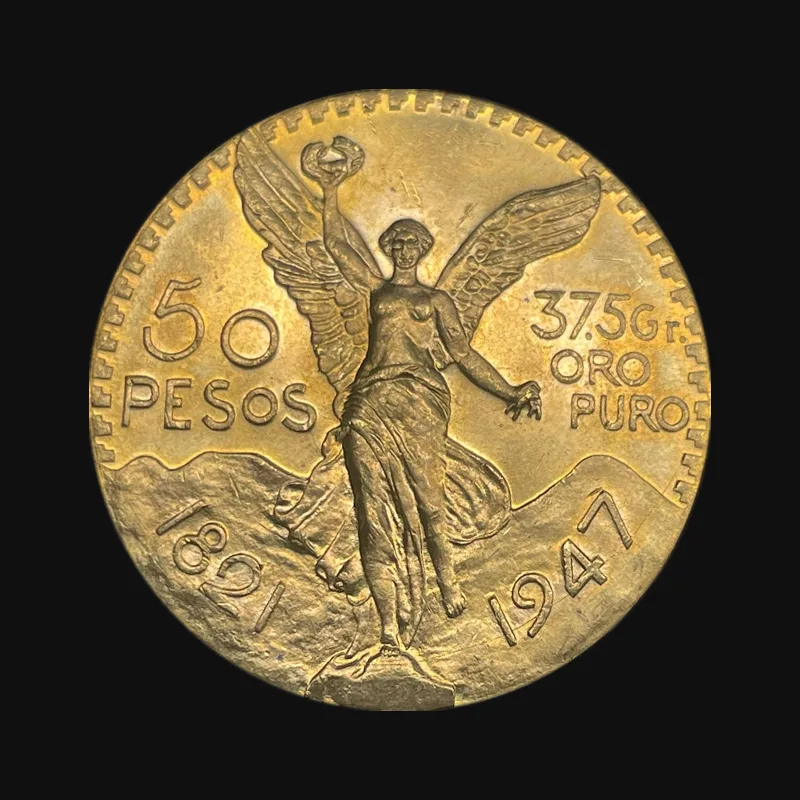
The winged Victory of Mexico City's “Ángel”, the statue on the Independence Column, with a laurel wreath and broken chains; in the distance, the volcanoes Popocatépetl and Iztaccíhuatl. Two inscriptions frame the figure: the value “50 PESOS” and the fineness statement “37.5 Gr. ORO PURO”. Two years can be read at the bottom, 1821 on one side (left), the year of striking on the other (right).
The table follows the order of the years. For a collector, the important rows are 1931 (137,000 pieces) and 1921 (180,000), then 1943, struck without a denomination. The 1947 row must be read together with the restrike rows, which are far larger.
| Year | Type | Mintage | Remarks |
|---|---|---|---|
| 1921 | Centenario | 180,000 | Anniversary year, low mintage. |
| 1922 | Centenario | 463,000 | |
| 1923 | Centenario | 432,000 | |
| 1924 | Centenario | 439,000 | |
| 1925 | Centenario | 716,000 | Highest figure between 1921 and 1931. |
| 1926 | Centenario | 600,000 | |
| 1927 | Centenario | 606,000 | |
| 1928 | Centenario | 538,000 | |
| 1929 | Centenario | 458,000 | |
| 1930 | Centenario | 372,000 | |
| 1931 | Centenario | 137,000 | Striking halted in the crisis; smallest mintage. |
| 1943 | Type without face value | 89,000 to 89,400 | Only date where the gold weight replaces “50 PESOS”. |
| 1944 | Centenario | 593,000 | Denomination engraved again. |
| 1945 | Centenario | 1,012,000 | |
| 1946 | Centenario | 1,588,000 | |
| 1947 | Centenario | 309,000 | Coins of the year, indistinguishable in practice. |
| 1949-1972 | Restrike (date 1947) | 3,975,654 | The bulk of the 50 pesos seen today. |
| 1996 | Restrike (date 1947) | unknown | Wikipedia and CoinWeek speak of nearly 8 million, then 302,000 pieces from 2000 to 2009; no official source consulted. |
Mintage sources: English and Spanish Wikipedia, which cite the Bank of Mexico; NGC for 1949-1972. The number of 1943 pieces differs between Greysheet and dealers.
Mexican independence dates from 1821. In 1921 the country, just through ten years of revolution, marked the centenary with a 50 pesos gold coin. On the reverse, Emilio del Moral took up the Victory that tops the Independence Column, raised in Mexico City in 1910 and nicknamed “El Ángel” by the population.
Interrupted in 1931 by the crisis, striking restarted in 1943 to meet the demand for gold coins. The Centenario keeps its legal value, but it is kept as a store of metal far more than it is spent. Its design was later reused by the Bank of Mexico for the Libertad coins, in gold and silver. For other gold coins from far away, see the gold coins section.
The date 1947 was used long after 1947. The Bank of Mexico struck new pieces with those dies to place its gold: 3,975,654 coins from 1949 to 1972, more series afterwards, in 1996 and in the early 2000s. These are not counterfeits: fineness, weight and design are those of the original coins, and no sign tells them apart.
A particularly bright, even mirror-like field and no traces of circulation are found on many restrikes. That is only a presumption. In practice it is almost impossible to state that a piece belongs to the 309,000 pieces actually minted in 1947.
The 1943 reverse is recognisable at first sight: no value in pesos, but the words “37.5 Gr. ORO PURO” placed on both sides of the Victory. Dealers' notes explain this choice by the wish to highlight the gold content. The denomination returned the following year.
This type has its own catalogue number, KM# 482, and a mintage of about 89,000 pieces, sometimes given as 89,400. Together with 1921 and 1931, it is the date collectors look at first.
Like any large gold coin, the Centenario has been copied. Start with a magnet: it should not grip, unlike many plated copies. Then check the 41.666 g on precise scales and the 37 mm with a caliper, without forgetting the thickness. A quality imitation can pass these measurements; it is then the fineness of the wing feathers and the volcanoes that gives it away. Each step is detailed in how to spot a fake coin.
The coin changed hands little, and wear often stays light. It first touches the Victory's high points (knee, chest, face), then erases the wing feathers, the wreath and the chains. On the other side, the eagle's breast and spread wing wear before the snake and the cactus. The weight makes edge knocks and contact marks common. For a restrike, condition matters little; for 1921, 1931 or 1943, it makes the difference. Avoid any cleaning and refer to the guide grades of preservation.
A major transatlantic port, Le Havre looked mainly towards New York; the Compagnie générale transatlantique's Mexico line left from Saint-Nazaire instead, opened in 1862 by the liner Louisiane bound for Veracruz. No direct link therefore joins the city to the Centenario, which was never legal tender in France. Some Normandy families nevertheless keep one, almost always dated 1947, alongside American gold coins such as the $20 gold coin.
Emilio del Moral, author of the model and engraver of the dies. The Bank of Mexico reused his design for the Libertad series.
41.666 g in total, of which 37.5 g is pure gold, for a diameter of 37 mm and a thickness of about 2.8 mm.
Read the year on the right below the Victory: it should say 1921, since 1821 is always engraved on the left. Its mintage was 180,000, which makes it much less common than the coins dated 1947.
No. It rules out copies plated on a magnetic metal, but a careful imitation also requires checking weight, diameter, thickness and relief, and if in doubt the opinion of a numismatist.