Obverse
Effigy of the Republic: Marianne in profile to the right, her Phrygian cap girded with oak leaves. Circular legend “RÉPUBLIQUE FRANÇAISE” (French Republic).
Written by the Maison Or & Bijoux Le Havre team · updated
| Country | France |
|---|---|
| Metal | Gold, 900‰ fine (a little less on the 1951-1960 restrikes) |
| Weight | 6.45 g |
| Fine gold | 5.806 g |
| Diameter | 21 mm |
| Thickness | 1.30 mm |
| Years struck | 1899 to 1914; extra batch of 1921 dated 1914; restrikes from 1951 to 1960 dated 1907 to 1914 |
| Mint | Paris only, no letter; nothing struck at Rouen (B) |
| Period mintage | 117,448,888 coins, i.e. 43,034,473 of the first type and 74,414,415 of the second |
| Restrikes | 37,483,500 coins |
| Edge | “DIEU PROTÈGE LA FRANCE”, then “LIBERTÉ ÉGALITÉ FRATERNITÉ”, in relief |
| References | Le Franc F.534 and F.535 |
The 20 francs Coq (Rooster) is the gold coin France struck during the Belle Époque, from 1899 to 1914, to a design by the Norman-born medallist Jules-Clément Chaplain. It was later reproduced on a large scale: first in 1921, then from 1951 to 1960, with old dates. So it fills many family boxes, where only certain years and lightly worn coins catch a collector's eye.
Effigy of the Republic: Marianne in profile to the right, her Phrygian cap girded with oak leaves. Circular legend “RÉPUBLIQUE FRANÇAISE” (French Republic).
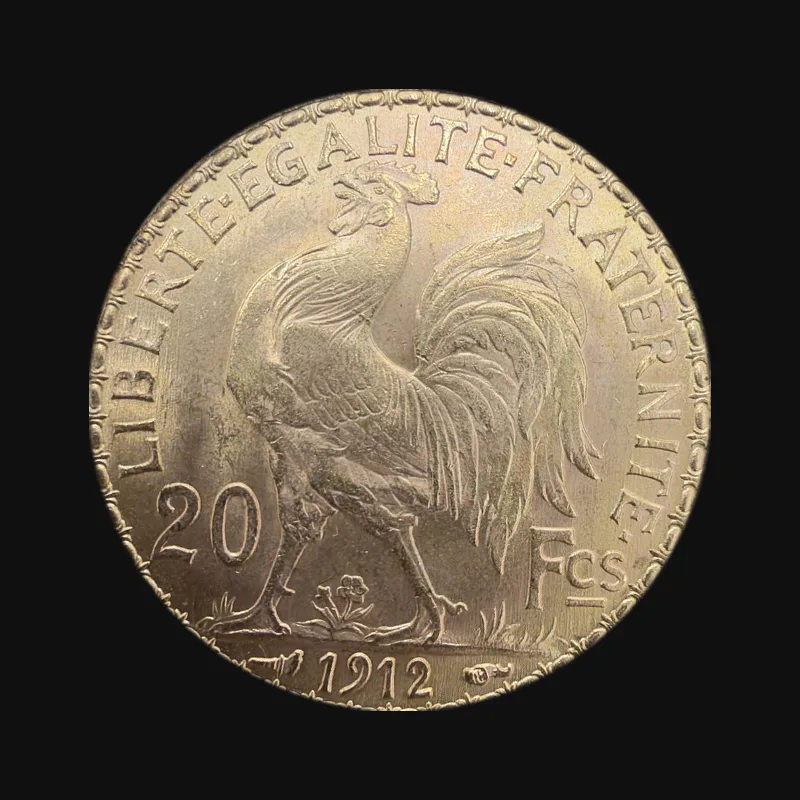
Rooster walking to the left, chest thrust forward. Value “20 FRANCS” and year on either side, motto “LIBERTÉ ÉGALITÉ FRATERNITÉ” as the legend. No mint letter, since every coin was struck in Paris.
A date from 1899 to 1906 means a coin struck in that year. From 1907 onwards, the date is no longer enough: the post-war restrikes carry the same years, and they are not counted below. The dates that deserve a careful look are 1900, the lowest, followed by 1899, 1902 and 1901.
| Year | Edge | Mintage | Comment |
|---|---|---|---|
| 1899 | Dieu protège la France | 1,500,000 | Opening year; matt flan |
| 1900 | Dieu protège la France | 605,982 | Series low; plus 9,443 matt flans |
| 1901 | Dieu protège la France | 2,643,350 | Small mintage |
| 1902 | Dieu protège la France | 2,393,707 | Small mintage |
| 1903 | Dieu protège la France | 4,405,175 | Common |
| 1904 | Dieu protège la France | 7,705,674 | Common |
| 1905 | Dieu protège la France | 9,158,132 | Common |
| 1906 | Dieu protège la France | 14,613,010 | Final date of the first type |
| 1907 | Liberté égalité fraternité | 17,715,935 | Series high; date reused after the war |
| 1908 | Liberté égalité fraternité | 6,721,325 | Date reused after the war |
| 1909 | Liberté égalité fraternité | 9,636,955 | Date reused after the war |
| 1910 | Liberté égalité fraternité | 5,779,072 | Date reused after the war |
| 1911 | Liberté égalité fraternité | 5,346,044 | Date reused after the war |
| 1912 | Liberté égalité fraternité | 10,331,805 | Date reused after the war |
| 1913 | Liberté égalité fraternité | 12,163,138 | Date reused after the war |
| 1914 | Liberté égalité fraternité | 6,720,141 | With 202,359 coins from 1921; date reused after the war |
Mintages come from French Wikipedia, which follows Le Franc, and were checked against BDOR. The two sources differ only for 1900: 615,425 at BDOR, which adds both kinds of flan together. The 1951-1960 restrikes (37,483,500 coins) must be counted on top, with no breakdown by year in the sources consulted.
In 1899, the Third Republic wanted a gold coin in its own image. It gave up the 20 francs Genius, struck until 1898, and entrusted the new model to Jules-Clément Chaplain, an established medallist. Marianne in her Phrygian cap and the Gallic rooster replaced the winged allegory; weight and fineness stayed true to the law of 1803.
The edge tells of a change of era. Up to 1906, it reads “DIEU PROTÈGE LA FRANCE”. From 1907, it received the motto of the Republic, at a time when Church and State had been legally separate for two years. Chaplain died in 1909: he saw neither the end of striking in 1914 nor the long second life of his coin.
From 1915, the war withdrew gold from trade; the poster “Pour la France, versez votre or” (For France, pour out your gold) asked the French to deposit it in exchange for banknotes. To place the Rooster among the coins of its time, see the page on coins of the Third Republic (in French).
Which date? It is read on the reverse, next to the rooster. From 1899 to 1906, the coin is a period strike; from 1907 to 1914, it may also come from the 1950s.
Which edge? Roll the coin to read the inscription. It must match the date: “DIEU PROTÈGE LA FRANCE” before 1907, the republican motto afterwards. A coin dated 1902 with the motto, or dated 1912 with “DIEU PROTÈGE LA FRANCE”, is a counterfeit.
Which measurements? A scale reading to the hundredth and a calliper give 6.45 g, 21 mm and 1.30 mm on a genuine coin. Wear takes off a few hundredths of a gram, never more.
Between June 1951 and 1960, the Paris Mint brought out the Rooster dies again and made 37,483,500 coins dated 1907 to 1914. French Wikipedia explains the operation by the wish to hold back the rise of gold on the free market. The nickname “Pinay restrikes” is later than the start of production: Antoine Pinay only became head of government in 1952.
These coins are official. Their only departure from the originals lies in the alloy, slightly richer in copper: 897.3 thousandths for French Wikipedia, 898 to 900 for AuCOFFRE. The gold may look redder, and the condition is often very good, for lack of circulation. But colour also depends on toning and light, and some period coins stayed new: only an alloy analysis can decide.
By volume of production, about one Rooster in three dated 1907 to 1914 is a restrike; the proportion among surviving coins is not known. The monetary background of those years is set out on the page on post-war coins (in French).
The genuine rarities are the matt flans of 1899 and 1900, with a dull, finely grained ground. Next come the regular dates with low mintages: 1900 (605,982 coins), 1899, 1902, 1901. The 202,359 coins made in 1921 bear the date 1914 and merge with the others. Finally, Le Franc mentions an 1898 pre-series on matt flan, which is not met with in inheritances.
Forgers have copied the Rooster a great deal, sometimes in gold of the right fineness. Besides measurements and edge, look at the fineness of Marianne's hair, the drawing of the feathers, the regularity of the edge letters and the sharpness of the beaded border. A mint letter engraved on a Rooster condemns it. The checks that need no specialist equipment are gathered in the guide to spotting a fake coin (in French).
On the obverse, wear first attacks the locks escaping from the cap above the forehead and the oak leaves, then the cheek and the edge of the cap. At Very Fine (TTB in French grading), strands and veins can still be told apart; at Fine (TB), the hair is no more than a plain surface.
On the reverse, the rooster's breast, its highest point, flattens first, ahead of the wing and the comb. An Extremely Fine (SUP) coin shows every breast feather.
The Rooster's smooth fields are wide and keep every rub, whether a knock, a hairline scratch or a dent in the rim. Coins kept in bags carry them without having circulated, and the grade suffers. Do not clean them: read why not to clean a coin and the grading guide (both in French).
The man who drew the Rooster was Norman. Jules-Clément Chaplain was born on 12 July 1839 in Mortagne-au-Perche, in the Orne, and died in Paris in 1909. His home town gave him a street and a monument by the sculptor Denys Puech, unveiled on 12 July 1914, a few weeks before the outbreak of the war that would halt the striking of his coin. Normandy, on the other hand, made no Roosters: the Rouen mint, letter B, had closed in 1858, and the whole series comes from Paris. Its story is told on the page on the Rouen mint.
Dated 1899 to 1906, it is a period coin. Dated 1907 to 1914, it may have been struck between 1951 and 1960; a red tint and a very fresh condition suggest so, but only an alloy analysis can confirm it.
Jules-Clément Chaplain, a medallist born in 1839 in Mortagne-au-Perche, in the Orne. He created the Marianne on the obverse as well as the rooster on the reverse.
No. The dates 1899 to 1906 all carry “DIEU PROTÈGE LA FRANCE”. A motto edge on such a date reveals a fake.
Above all 1900, struck in 605,982 examples, and its 9,443 matt flan coins. Then 1899, 1902 and 1901, followed by coins of any date in very fine condition.