Skip to content
France

The gold 100 francs, from Napoleon III to the Genius

France · 1855-1914 · Gold

Written by the Maison Or & Bijoux Le Havre team · updated

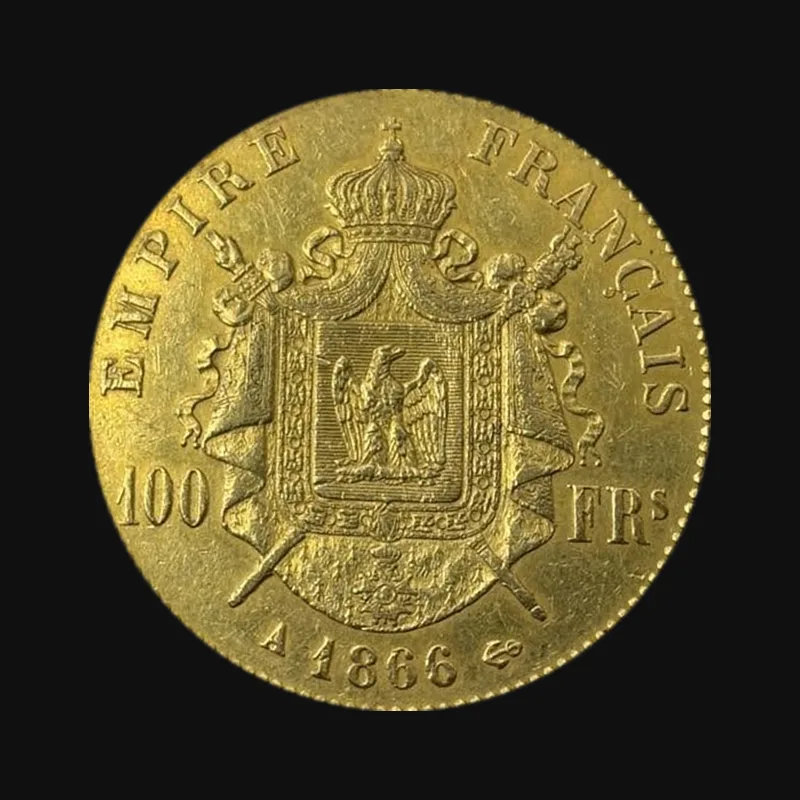
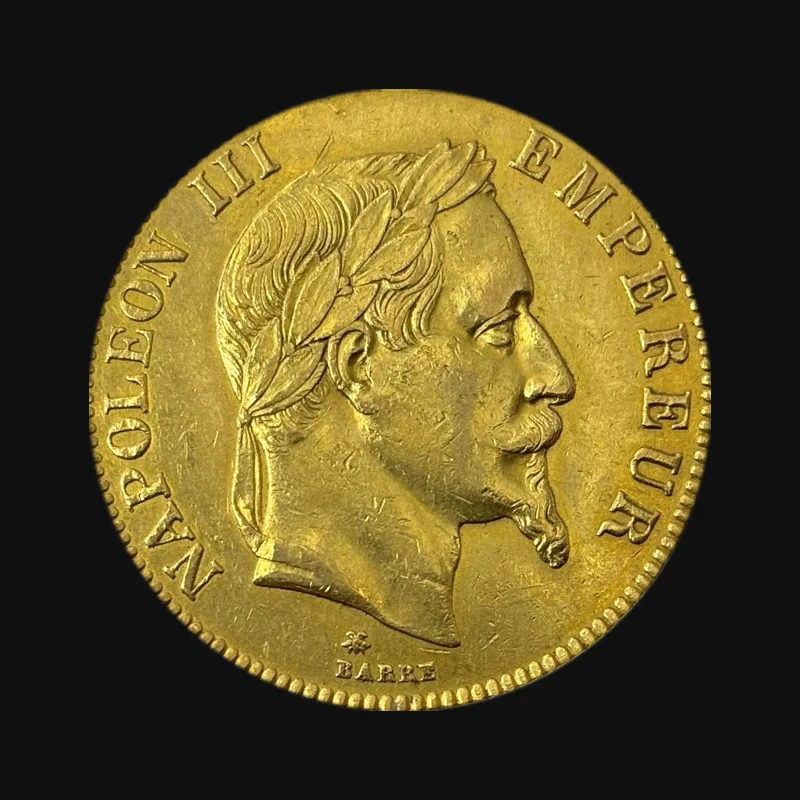
100 francs gold Napoleon III laureate head, obverse100 francs gold dated 1866, Paris mint (A), reverse with the imperial arms
Photos: Maison Or & Bijoux.
Specifications
CountryFrance
MetalGold, 900‰ fineness
Weight32.26 g
Fine gold29.032 g
Diameter35 mm
Striking1855 to 1859, 1862 to 1870, then 1878 to 1914 (Genius)
MintsParis (A) and the BB mint from 1855 to 1869; Genius: Paris only
EngraversThe Barre family; Genius model: Augustin Dupré
EdgeRaised: religious formula up to 1906, republican motto afterwards
Quantities struckAbout 443,000 imperial coins (346,514 + 96,950), 438,595 Genius
Catalogue numbersF.550, F.551, F.552, F.553 (Le Franc); KM 786, KM 802, KM 832 for the 1878-1906 Genius; Gadoury 1135 to 1137 (CoinVarieties)

The germinal franc never had a bigger gold coin: the 100 francs measures 35 mm and weighs 32.26 g, at 900 fine. Napoleon III introduced it in 1855 with his portrait, first bare-headed then laureate; the Third Republic took it over in 1878 with Dupré's Genius, up to the 1914 date. The few imperial coins come from two mints; the Genius was made entirely in Paris.

Identification

The gold 100 francs, from Napoleon III to the Genius: how to recognise it

100 francs gold Napoleon III laureate head, obverse

Obverse

Napoleon III in profile, facing right, within the legend “NAPOLEON III EMPEREUR”: bare head from 1855 to 1859, laureate head from 1862 to 1870, the engraver's name BARRE legible under the truncation of the neck. Genius: a standing winged figure engraving a tablet, with a fasces topped by a hand of justice on one side and a rooster on the other; legend “RÉPUBLIQUE FRANÇAISE”.

100 francs gold dated 1866, Paris mint (A), reverse with the imperial arms

Reverse

Second Empire: the great imperial arms, an eagle on a thunderbolt in the centre of the Legion of Honour collar, before a mantle; legend “EMPIRE FRANÇAIS”; value “100 FRS” divided by the shield; mint letter and date below. Third Republic: value and date inside a wreath.

Edge
Raised letters all around. The formula “DIEU PROTEGE LA FRANCE” (God protect France) for the Empire and for the Genius from 1878 to 1906, the motto “LIBERTÉ ÉGALITÉ FRATERNITÉ” for the Genius from 1907 to 1914. Patterns and burnished flans carry no inscription.
Engraver
Laureate head and Genius: Désiré-Albert Barre, the Genius taking up a 1792 composition by Augustin Dupré. Bare head: BDOR and Abacor name Désiré-Albert, CoinVarieties his father Jacques-Jean.
Dates and mintages

The gold 100 francs, from Napoleon III to the Genius: key dates

This list dwells on the Paris dates of the laureate head, often overlooked, and on how the Genius evolved, from the lean years of the late 19th century to the steady output before 1914. The two smallest figures in the whole series: 1889 (100) and 1894 (143).

The gold 100 francs, from Napoleon III to the Genius: dates and mintages
YearMintCoins struckNote
1855A50,901Year of creation
1856A56,803
1857A103,447Largest imperial mintage
1858A92,050
1858BB1,928Very low
1859A21,626Last Paris bare head
1863BB5,078Only mint at work that year
1864A5,536Paris returns
1865A1,517Lowest imperial mintage
1867A4,309
1868A2,315Low
1868BB1,982Low
1869A28,872
1870A10,460Almost all melted, according to BDOR
1878A12,814World's fair; 30 burnished flans
1879A38,601Plain anchor and barred anchor
1885A2,894
1889A100World's fair
1904A20,000
1907A20,000New edge
1911A30,067
1913A30,184
1914A1,281Struck in 1921

Figures from BDOR and Abacor, which agree; type split according to Le Franc. BB dates not repeated here: 1855 (5,049), 1859 (14,710 according to BDOR, 14,698 according to CGB after Le Franc 2023, 9,305 according to CoinVarieties), 1862 (3,078), 1866 (3,075), 1867 (2,807), 1869 (12,230 according to BDOR, 14,412 according to CoinVarieties). Other low Genius dates: 1887 (234) and 1896 (400). For 1879, a single total is known for both privy marks.

Dating the coin in four steps

  1. Measure: 35 mm and 32.26 g mean a 100 francs; at 28 mm, it is a 50 francs of the same design.
  2. Look at the obverse: an emperor without laurel means 1855 to 1859; with laurel, 1862 to 1870; a winged Genius, 1878 to 1914.
  3. Find the letter below the imperial arms: A for Paris, BB for the other mint; the Genius only has A.
  4. Read the edge of a Genius: the old formula ends in 1906, the republican motto begins in 1907.

The guide to mints (in French) lists the letters on all French coins.

Why imperial coins are scarce

For a gold coin, the Empire struck this size sparingly: fewer than 450,000 pieces in sixteen years, both types together. The laureate head, from 1862 to 1870, does not reach 100,000 coins in total. Some Paris dates drop to a few thousand, such as 1865 (1,517) or 1868 (2,315), and the BB mint never exceeded 15,000 coins a year.

The last year adds a loss: according to BDOR, the 10,460 coins of 1870 were almost all melted down. The coin itself had been created, with the 50 francs, by a decree of 12 December 1854, according to BDOR and Abacor. The Napoleon III gold 5 francs and the Napoleon III gold 20 francs belong to the same family of portraits, on much smaller sizes.

1907: the edge changes, as on the Rooster

Taken up by the Republic in 1878, the size received Dupré's Genius. The first decades were irregular: the world's fair years, 1878 and 1889, frame dates with only a few hundred coins. Then, from 1899 to 1913, Paris struck roughly 10,000 to 30,000 examples each year.

In 1907 the edge inscription dropped “DIEU PROTEGE LA FRANCE” for “LIBERTÉ ÉGALITÉ FRATERNITÉ”. The gold 20 francs Rooster went through the same change that same year. An edge that does not fit the date should raise suspicion.

The 1914 date was not struck until 1921, in 1,281 examples, and the law of 25 June 1928 on the Poincaré franc then demonetised the coin, again according to BDOR and Abacor. The page on Third Republic coins (in French) covers the rest of the period.

Patterns, proofs and imitations

Several pieces stand out from the ordinary. For 1855, Le Franc and BDOR cite a Paris proof with no edge inscription, with an A on the obverse, and patterns. For 1861, BDOR alone describes proofs on burnished flans where a star replaces the bee at the neck (five points) and the mint letter (six points). Patterns of 1862 and 1868 round off the Empire.

In 1878 the Republic added two patterns and 30 coins on burnished flans; a burnished flan striking dated 1900 also exists, and 1879 comes with two privy marks: the plain anchor and the barred anchor.

Imitations exist, in low-grade gold as well as gilt metal. A coin too light or too thick for its diameter, an unusual tint, misaligned edge letters or soft relief should cast doubt. See the guide to recognising a fake coin (in French).

Reading the grade

Napoleon III bare head: watch the locks above the ear and the relief of the cheek. Laureate head: the veins of the leaves. Imperial reverse: the eagle's feathers, the bundle of the thunderbolt, the links of the collar. Genius: the shoulder and chest wear before the wings and the rooster; on the reverse, the wreath leaves go smooth.

Large gold coins also carry handling knocks, on the edge as well as in the fields. Even without wear, many marks lower the grade. Do not try to clean the coin. Explanations are in the guide to grades and on the page about cleaning coins (both in French).

Same name, different coin

At least three coins share the face value without being the same issue. The Bazor gold 100 francs (1929-1936) measures 21 mm for 6.55 g and shows a head of the Republic in a Phrygian cap; it never served in everyday life. The commemorative silver 100 francs of 1982 to 2001 and the Paris Mint's collector gold 100 francs are modern issues. Lastly, Monaco had gold 100 francs of the same size struck in Paris under Charles III and Albert I, recognisable by the princely arms and the words “CENT FRANCS”.

To place the coin among its contemporaries, see 19th-century French coins and gold coins (in French).
In Le Havre

The gold 100 francs, from Napoleon III to the Genius in Normandy

The Norman mint at Rouen, whose coins bear the letter B, could have struck the 100 francs: it was still working when the coin was born in 1855. Yet it produced none. Catalogues know only the letters A and BB for this size, and Rouen's last strikings are bronzes of 1857, before the mint closed in 1858. A 100 francs found in a Le Havre family therefore necessarily comes from Paris or from the BB mint. The story of the Norman mint is told on the Rouen mint page; for your own coin, a free valuation lets you show it to a numismatist.

The gold 100 francs, from Napoleon III to the Genius: frequently asked questions

Is there a gold 100 francs struck in Rouen?

No. Only Paris (A) and the BB mint struck this size under Napoleon III, and the Genius only bears the letter A. Rouen stopped striking after its 1857 bronzes.

My Genius 100 francs is dated 1914: is it from 1914?

It bears that date, but BDOR and Abacor state that it was made in 1921, in only 1,281 examples.

How many laureate-head 100 francs were struck?

96,950 in total between 1862 and 1870, Paris and the BB mint combined, according to BDOR and Abacor.

Are the 1878 and 1889 gold 100 francs linked to the world's fairs?

They bear the dates of the two Paris world's fairs. In 1889, only 100 coins were struck, the lowest mintage in the series.