Skip to content
France

The 20 francs Genius in gold

France · 1848-1898 · Gold

Written by the Maison Or & Bijoux Le Havre team · updated

Pièce de 20 francs or au Génie, revers
Photo: Maison Or & Bijoux Strasbourg.
Specifications
CountryFrance
MetalGold (900‰)
Weight6.45 g
Fine gold5.806 g
Diameter21 mm
Years1848-1849; 1871, 1874-1879 and 1886-1898
MintA, Paris
Coins struck2,846,061 (Second Republic); nearly 86 million (Third Republic)
Le Franc catalogueF.528 and F.533

The 20 francs Genius (Génie) takes its name from the winged allegory engraving a tablet on its obverse, the work of Augustin Dupré in 1792. The Paris Mint struck it under the Second Republic, in 1848 and 1849, then under the Third, from 1871 to 1898: about 89 million coins in all. Inheritances often contain some, almost always of common dates; only a few low-mintage years stand out.

Identification

The 20 francs Genius in gold: how to recognise it

Obverse

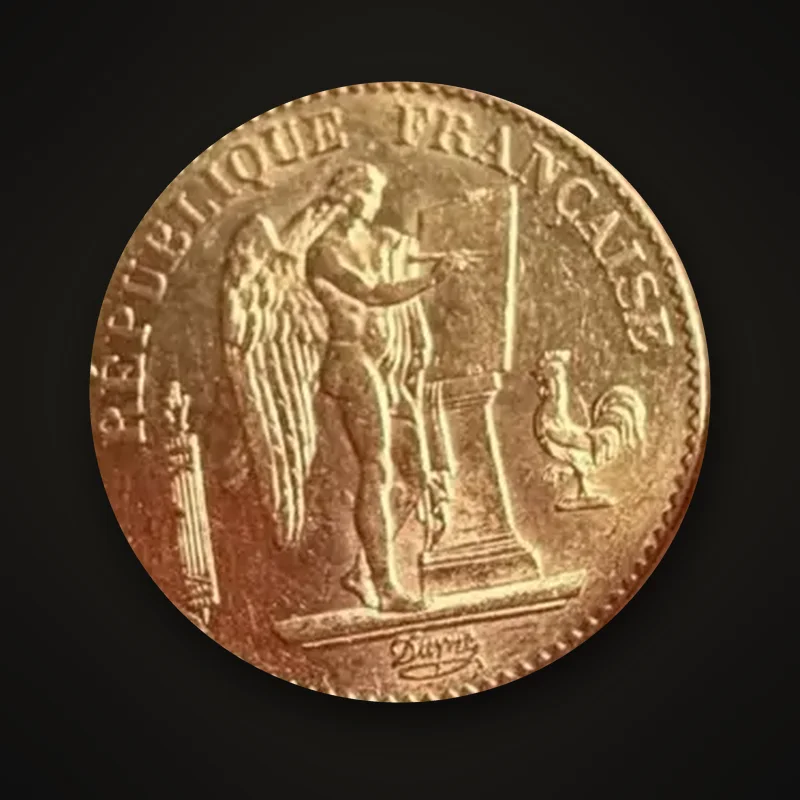
It shows the Genius of the Republic, winged, standing and facing right, engraving a tablet set on an altar; a rooster to the right, a fasces topped by a hand of justice to the left. Signature “Dupré” at the bottom, and around the rim, “RÉPUBLIQUE FRANÇAISE”.

Pièce de 20 francs or au Génie, revers

Reverse

Value “20 FRANCS” and date at the heart of a closed wreath, with the mint mark A below the date. Legend: “LIBERTÉ ÉGALITÉ FRATERNITÉ”.

Edge
Raised: “DIEU * PROTEGE * LA * FRANCE”, i.e. God protect France, the same inscription under both Republics. The thirty burnished flans of 1878 were left with a plain edge.
Engraver
Augustin Dupré, appointed chief engraver during the Revolution, signed the design in 1792; the Second and Third Republics took it up as it was.
Dates and mintages

The 20 francs Genius in gold: key dates

Since the letter A is shared by every coin, the date is what you need to read. The plentiful years, 1875 to 1878 and 1895 to 1898, are the ones you almost always come across. The low mintages fall between 1886 and 1894: look first for 1888, then for 1892.

The 20 francs Genius in gold: dates and mintages
YearMintMintageNote
1848A1,543,091Second Republic; also on burnished flan
1849A1,302,970End of the type under the Second Republic
1871A2,508,494The Genius returns
1874A1,284,554No striking in 1872 and 1873
1875A11,677,031Common
1876A8,824,658Common
1877A12,759,057Peak mintage
1878A9,188,600Plus 30 burnished flans (plain edge)
1879A1,037,522Plain anchor, barred anchor
1886A984,875End of the 1880-1885 pause
1887A1,231,487Low
1888A27,707Major rarity
1889Aabout 850,000 to 875,000Depends on source; 100 extra burnished flans
1890A1,030,140Fairly low
1891A871,101Low
1892A225,706Second rarity
1893Aabout 2.5 millionCommon; total disputed
1894A490,838Low
1895A5,293,347Common
1896A5,330,407Fasces, or torch
1897A11,068,977Common
1898A8,866,327The Rooster follows in 1899

1848-1849: BDOR figures. 1871-1898: Numista figures, matching Le Franc numbers F.533/1 to F.533/23 and, for 1874, 1875 and 1879, verified on CoinVarieties. The mintages for 1889 (853,468, 873,000 or 873,090) and 1893 (2,457,168, 2,517,168 or 2,547,168) change with the source consulted, so the Third Republic total rounds to about 86 million. No striking in 1880, 1881, 1882, 1883, 1884 or 1885.

From revolutionary Genius to republican napoléon

In 1792, the chief engraver Augustin Dupré drew this Genius busy engraving a tablet for the young First Republic. The design waited until 1848 to reach a gold 20 francs: the Second Republic had it struck in 1848 and again in 1849, before the Empire put the emperor's profile on the Napoleon III 20 francs.

In 1871, the Third Republic took up the Genius at once. The 1870s were prolific; then nothing from 1880 to 1885, and modest volumes until 1894, the period every rare date comes from. Output picked up strongly in 1895. The Genius followed the Latin Monetary Union's rules and was used for everyday payments in France until 1914.

In 1899, Jules-Clément Chaplain's 20 francs Rooster took over, at the same weight. The Genius did not vanish, though: it still adorned the gold 50 francs until 1904 and the gold 100 francs until 1914. The nickname “angel”, often used in French, comes from the figure's wings, yet the figure is a republican allegory. For the wider period: Third Republic coinage (in French).

Varieties worth knowing

For any one date, the only recognised differences concern the privy marks, tiny reverse symbols, one for the Mint director and one for the chief engraver. 1879 exists with a plain anchor or a barred anchor. 1896 exists with a fasces or with a torch; the Le Franc catalogue gives each a separate number.

Burnished flans form a category of their own: presentation pieces, struck in 1848, in 1878 (30 coins, plain edge) and in 1889 (100 coins). They were not meant to circulate and stand apart from the regular coins of the same year.

A doubtful coin: the checkpoints

Start with the mint letter: since Paris was the only mint for the Genius, any mark other than A is enough to make the coin suspect. Then check weight and size, 6.45 g for 21 mm, and the edge, which should be crisp and even.

Period or modern counterfeits, sometimes cast in gold of the right fineness, often show soft details: barely marked wing feathers, a blurred rooster, irregular edge letters. Rare dates raise another problem. An 1888 or an 1892 may be a genuine coin of a common year whose last digit has been changed: examine its shape and alignment under a loupe, along with scratches or unusual polish in the field around it. The gold is real, the rarity is not. Each step is set out in our French page on fake coins.

Wear: where to look

On the obverse, wear first attacks whatever stands highest: the Genius's head, shoulder and chest. The wing feathers fade next, then the rooster's detail and the rods of the fasces. As long as the feathers stay separate and the profile is sharp, it grades Very Fine (TTB in French terms); once the wings turn smooth and the rooster loses its detail, it is Fine (TB).

On the reverse, the wreath is the right indicator: do its leaves keep their veins? The legends, close to the rim, fade too late to serve as a guide. Small knock marks in the fields, even on a lightly circulated coin, also lower the grade. Never rub the coin to make it shine: its original lustre would be lost. Further reading, in French: grades of preservation and the risks of cleaning.
In Le Havre

The 20 francs Genius in gold in Normandy

Dupré's Genius was indeed struck in Normandy, but not on this coin. In 1792, the Rouen mint, letter B, placed it on the reverse of the six-livre constitutional écu, where the allegory engraves the word “CONSTITUTION”; a Rouen example is shown on the page on the Rouen mint. The 20 francs Genius, for its part, never left Paris: catalogues record no letter B for it, and the Rouen mint, whose last coins are dated 1857, closed in 1858, long before the Genius returned in 1871. In an estate from the area, it may sit next to the 20 francs Rooster or the British sovereign; the Le Havre shop can read its date and grade.

The 20 francs Genius in gold: frequently asked questions

Is my 20 francs Genius from the Second or the Third Republic?

Look at the date: 1848 or 1849 means the Second Republic; any year from 1871 to 1898 means the Third. The design did not change between the two.

Was the 20 francs Genius struck in Rouen?

No. The whole series carries the letter A of Paris. Rouen struck Dupré's Genius in 1792, but on the six-livre écu, and the mint closed in 1858.

Which dates should I set aside?

1888 first (27,707 coins), then 1892 (225,706) and 1894 (490,838). 1886, 1889 and 1891 stay under a million. A numismatist will check that the date has not been altered.

Why do some people call this coin the “angel”?

Because of the figure's wings. It is in fact the Genius of the Republic, an allegory, and not an angel in the religious sense.