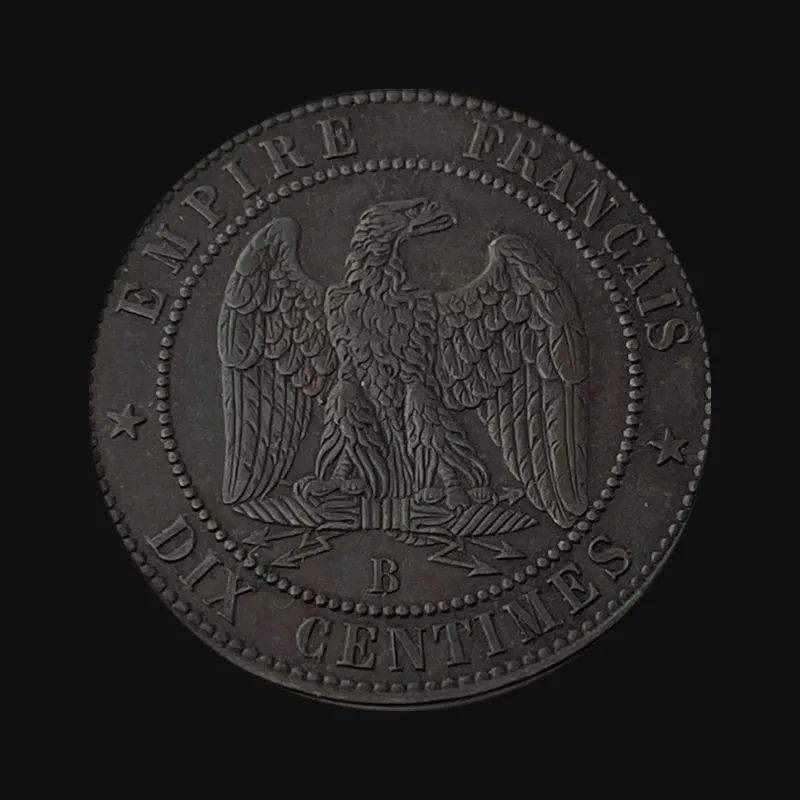
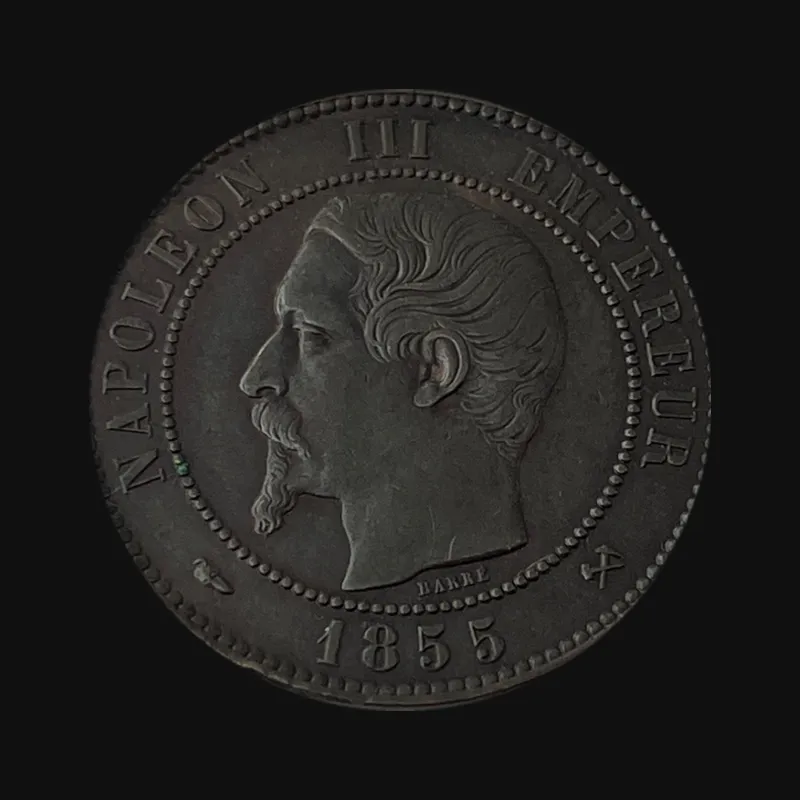
The “dog”: a privy mark, not a name for the eagle
In catalogues and sale lists you will read “10 centimes 1855 A chien” or “5 centimes 1855 ancre”. The word points to the symbol to the left of the BARRE signature, under the emperor's neck. Until 1855 it is a dog's head, a greyhound's head to be precise according to the Musée Carnavalet records: the mark of Jacques-Jean Barre, Chief Engraver. His son Albert-Désiré took over in 1855 and used an anchor. So every coin from 1852 to 1854 carries the dog, every coin from 1856 and 1857 the anchor, and 1855 has both.
So the word does not refer to the eagle on the reverse. Remember the privy mark: it is what the coins are sorted by.
To the right of the signature is the mint's symbol: a hand for Paris, a lion for Lyon, a hammer for Rouen, described by the Musée Carnavalet as a crossed pick and sledgehammer. Together with the letter under the eagle, it confirms where a coin was struck when the letter is worn. The guide to French mints lists the other letters.
The copper recoinage and the seven mints
In the early 1850s, France's small change was a jumble of liards, sous and copper centimes, some older than the Revolution. The law of 6 May 1852 ordered them withdrawn and replaced by a light, accurately sized bronze coinage: one gram per centime, from 1 gram for the centime to 10 grams for the ten.
To melt and restrike such volumes, the authorities did not rely on Paris, Strasbourg and Bordeaux alone. They brought Lille, Marseille, Lyon and Rouen back into service. The 10 centimes opened the series in 1852, in Paris only; all four coins then came from seven mints between 1853 and 1857. The 5 and 10 centimes dominate: between them, over 670 million pieces in those years.
Striking stopped in 1857 and resumed in 1861 with the laureate head, at just three mints: A, BB and K. The mints reopened for the recoinage had by then ceased work. These bronzes stayed in use into the twentieth century; Coinvarieties states that the 10 centimes of this type were demonetised in 1935. The period is covered on the page on nineteenth-century French coins; the centimes and décimes of the Revolution have their own page on the Dupré décimes and centimes.
Varieties and coins not to confuse
1855, the double year. The change of engraver happened within the year. For several mints, Le Franc lists two numbers for the same date, and as many as eight for the Lyon 2 centimes. In Paris, the two 10 centimes numbers are the dog and the anchor. Check the left-hand symbol before drawing conclusions.
Satirical pieces. After Sedan, in 1870 and 1871, ordinary bronzes were re-engraved by hand: a spiked helmet on the emperor's head, the eagle turned into a bat or an owl, sometimes a pig's profile. The engraving is deep and uneven, and the original date can still be read. These are not mint varieties but period objects, collected separately.
The Lille visit. Medal-pieces the size of a 10 centimes, dated 1853, commemorate the Emperor and Empress's visit to the Lille stock exchange in September 1853. According to Coinvarieties, about a thousand were struck, in bronze, silver and gold.
Patterns. Le Franc records patterns of the laureate head dated 1861 and 1868, and the Musée Carnavalet holds a gold pattern of a 10 centimes dated 1854.
Circulating forgeries are rare on such small coins; the guide to spotting fakes gives the basic checks.
Judging the grade of a Napoleon III bronze
These coins were used every day for decades, and most turn up in Fine or Very Good condition. As a rule, on the obverse, wear first attacks the hair above the ear, then the moustache and goatee. On the laureate head, the leaves of the wreath lose their veins before merging into the hair. On the reverse, look at the breast feathers of the eagle and the zigzags of the thunderbolt: crisp on a Very Fine coin, they become a smooth mass on a worn one.
Bronze adds a test that gold does not have: colour. An uncirculated coin keeps an orange-red tone that turns red and brown, then brown, with time. American grading services record these stages as RD, RB and BN. A coin with full original red is the exception.
Watch also for verdigris and black corrosion spots, common on coins found in the ground. Do not rub them or soak them in vinegar: a stripped bronze takes on an even pink colour that any numismatist spots at once. The guide on cleaning coins explains why, and the guide to grades describes each level.