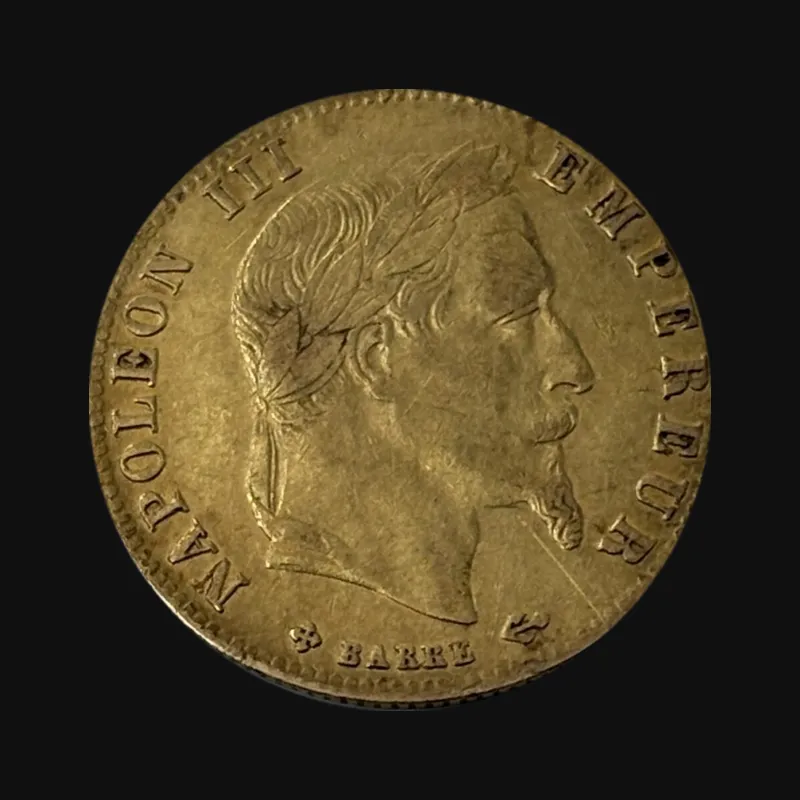
Obverse
Profile of Napoleon III facing right: bare head from 1854 to 1860, laureate head with a ribbon falling to the nape from 1862 to 1868. Legend: “NAPOLEON III EMPEREUR”. The signature BARRE sits below the neck.
Written by the Maison Or & Bijoux Le Havre team · updated
| Country | France |
|---|---|
| Metal | Gold, 900‰ fine |
| Weight | 1.6129 g (1.61 g in practice) |
| Fine gold | 1.4516 g |
| Diameter | about 14.4 mm (small module, 1854-1855); 16.7 mm (bare head, 1855-1860); 17 mm (laureate head) |
| Years struck | 1854-1855 small module; 1855-1860 bare head, large module; 1862-1868 laureate head |
| Mints | A (Paris) and BB (Strasbourg); none struck at Rouen (B) or Lyon (D) |
| Total mintage | 4,499,940 small modules; 24,182,654 large bare heads; 18,006,784 laureate heads |
| Edge | Plain (part of 1854), then reeded |
| References | Le Franc F.500 and F.500A (small module), F.501 (large module), F.502 (laureate head); KM 787 for the bare head, KM 803 for the laureate head |
This is the smallest gold coin of the Second Empire: just over a gram and a half, barely the size of a fingernail. It is recognised by the words “5 FRANCS” on two lines inside a laurel wreath, behind the emperor's profile. Nearly 47 million were struck between 1854 and 1868, which is why it so often turns up in family collections, tucked between larger coins.
Profile of Napoleon III facing right: bare head from 1854 to 1860, laureate head with a ribbon falling to the nape from 1862 to 1868. Legend: “NAPOLEON III EMPEREUR”. The signature BARRE sits below the neck.
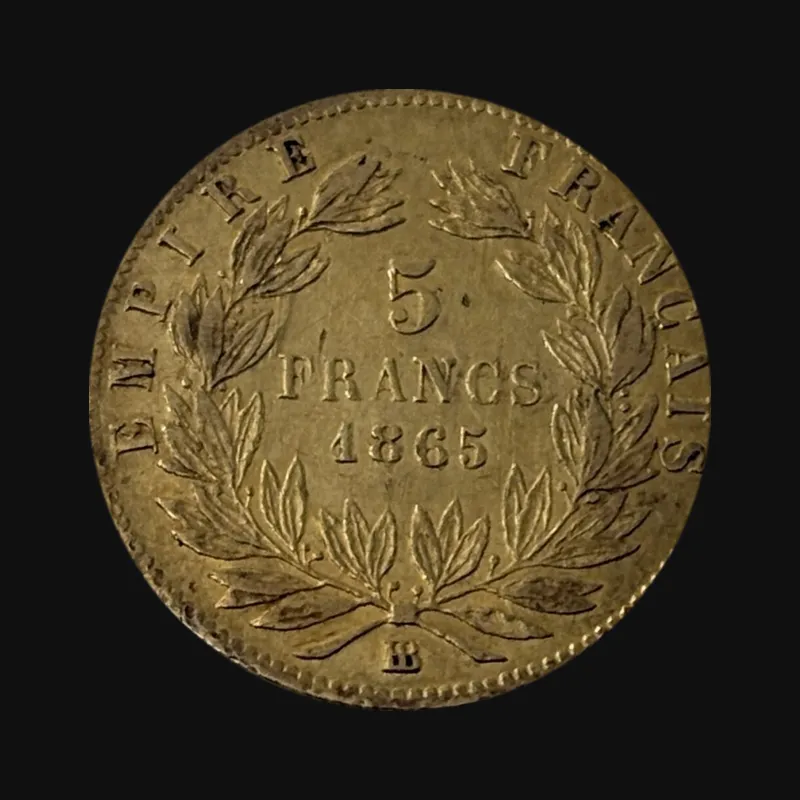
On all three types: “5 FRANCS” on two lines with the date beneath, inside a wreath of two laurel branches tied at the bottom. Legend: “EMPIRE FRANÇAIS”. The mint mark is below the bow, flanked by two small privy marks.
The table runs in date order and keeps the three types apart. The lines to examine more closely are the low mintages: the 1855 large module, the 1858 BB and, to a lesser degree, the 1855 small module. Paris coins of 1856 to 1860 make up the bulk of what you will meet. No coin is dated 1861: the bare head ends in 1860 and the laureate head only begins in 1862.
| Year | Mint | Mintage | Note |
|---|---|---|---|
| 1854 | A | 3,562,208 | Small module, 14.4 mm, plain then reeded edge; burnished flans known |
| 1855 | A | 937,732 | Small module, final year; 936,176 according to CGB |
| 1855 | A | 1,352 | Large module, 16.7 mm, very first striking; patterns known |
| 1856 | A | 2,960,085 | Variety with 6 re-engraved over a 5 |
| 1857 | A | 3,479,167 | Paris alone that year |
| 1858 | A | 2,982,985 | Common |
| 1858 | BB | 31,488 | First and smallest BB mintage of the type |
| 1859 | A | 5,659,773 | Largest annual mintage of the gold 5 francs |
| 1859 | BB | 2,247,999 | Common |
| 1860 | A | 4,798,130 | 6 over 5 variety; a variety with the bee privy mark is reported |
| 1860 | BB | 2,021,675 | 6 over 5 variety; last bare head |
| 1862 | A | 1,100,515 | First laureate head; 1,177,494 according to Heritage; burnished-flan pattern |
| 1862 | BB | 882,075 | Same figure from BDOR and Heritage |
| 1863 | A | 1,590,708 | |
| 1863 | BB | 1,103,564 | |
| 1864 | A | 2,239,561 | Most plentiful year of the laureate head |
| 1864 | BB | 899,564 | |
| 1865 | A | 824,020 | Smallest Paris mintage of the laureate head |
| 1865 | BB | 927,585 | |
| 1866 | A | 1,948,610 | |
| 1866 | BB | 1,388,489 | |
| 1867 | A | 1,006,173 | |
| 1867 | BB | 1,504,435 | |
| 1868 | A | 1,864,491 | Final year of the type |
| 1868 | BB | 726,994 | Smallest mintage of the laureate head |
Mintages taken from the BDOR tables for all three types; BDOR's totals match the sum of the lines. Cross-checks: 1855 A small module (936,176 at CGB), 1862 A and 1862 BB (Heritage, quoted by Stash of Coins). CGB gives no figure for 1858 BB and describes it as scarce. Each line covers all varieties of one year and one mint. Varieties from Le Franc (F.500 to F.502).
The weight never changes: 1.61 g of 900‰ gold, a quarter of a 20 francs Napoleon III. What changes is the size and the portrait.
The small module, created by decree on 12 January 1854, is only about 14.4 mm across. The earliest pieces have a plain edge; a decree of July 1854 then called for a reeded one. This tiny format did not last. As early as July 1855, a ministerial decision sent 888,000 of these coins back for melting, and the type was demonetised in 1859. Survivors are therefore few, particularly for 1855.
The large bare-head module replaced it in 1855: the same weight on a wider, thinner flan of 16.7 mm. Paris struck only a few hundred in the first year, then millions a year until 1860.
The laureate head arrived in 1862, rounded up to 17 mm. Unlike the 20 francs of the same period, its reverse never switched to the imperial arms and keeps the laurel wreath. To tell the two large modules apart, look at the head, not the reverse. Striking stopped in 1868, two years before the fall of the Empire.
The usual mix-up is with the gold 10 francs of the same reign. Size alone will not settle it: the first bare-head 10 francs, struck in 1854 and 1855, measures 17 mm, almost exactly like a large-module 5 francs. Two checks remove any doubt. First, read the figure inside the wreath. Then weigh the coin: a 10 francs is twice as heavy, about 3.22 g against 1.61 g.
The second trap is the small silver coinage of Napoleon III. The 50 centimes is close in size (18 mm) and carries the same profile, but it is white metal, reads “50 C” and weighs 2.5 g. These coins have their own page on the silver fractional coins. The silver 5 francs is hardly a risk at 37 mm and 25 g.
Finally, a gold 5 francs of the Ceres type was struck under the Third Republic between 1878 and 1889. It bears no emperor's portrait.
The catalogues list a few date varieties. The 6 re-engraved over a 5 exists for 1856 at Paris and for 1860 at both mints: under a 10× loupe you can make out the loop of the old figure beneath the new one. BDOR also notes an 1860 A variety with the bee privy mark. The bee is the mark of Alfred Renouard de Bussière, director of the BB mint until 1860, who then took charge of the Paris Mint. Burnished flans of 1854 and patterns of 1855 and 1862 complete the list; they rarely leave major collections.
The most common problem is not forgery but alteration. Small and light, the coin was often mounted as jewellery: pendant, charm, cufflink. Look on the edge for solder, flattened reeding or a filled hole, and on the faces for a polished patch. Collectors turn away from such pieces.
For copies, apply the basic checks: 1.61 g, the right diameter for the type, even reeding on the edge and a crisp BARRE signature. A gilt brass copy is too light for its size, and a different metal showing through a scratch gives the game away. The guide to fake coins (in French) sets out further methods.
On a 17 mm flan the details are tiny, so work with a 10× loupe and a low, raking light. On the bare head, wear shows first on the hair above the ear and on the cheekbone, then the goatee merges into the neck. On the laureate head, the leaves of the wreath lose their veins and blend into the hair.
On the reverse, look at the laurel branches: on a lightly worn coin each leaf keeps its central vein. The bow at the bottom and the two privy marks either side of the mint letter fade next.
Many family pieces fall between Fine and Very Fine. An Extremely Fine coin keeps some original lustre around the letters. Do not clean it: on so small a surface the slightest scratch shows. Grades are explained in the guide to conservation grades, and the risks of cleaning in the one on cleaning coins (both in French).
The great inflows of Californian and then Australian gold in the early 1850s made the yellow metal plentiful in France. After a first 10 francs of the Ceres type in 1850, the imperial government extended the range downwards: the gold 5 francs was born in 1854, the same year as the 10 francs bearing the emperor's portrait. It circulated alongside the silver crown of the same denomination, a far bulkier coin.
After the false start of the small module, the large module took hold. Paris carried out most of the striking; the BB mint joined only in 1858. In 1865 the Latin Monetary Union set common standards for the gold coinage of France, Belgium, Italy and Switzerland, and the gold 5 francs was among the denominations it covered.
Production ended in 1868. The coins stayed in use until the First World War and were only officially withdrawn in 1928. To place the type among its contemporaries, see the pages on nineteenth-century French coins and gold coins.
The gold 5 francs of Napoleon III was never struck in Rouen: the Le Franc catalogue (F.500 to F.502) and the mintage tables know only the letters A and BB. In its final years the Norman mint struck nothing but bronze, until 1857. The regional link lies with banking instead: the Banque du Havre, founded in 1837, was absorbed into the Banque de France in 1848, and the town received one of its branches. It was the same Banque de France that in 1855 handed 888,000 small-module coins over for melting, though how many came from Normandy is not known. The story of the mint is told on the Rouen mint page (in French).
Yes, if it is dated 1854 or 1855 and shows the bare head: it is the small module, struck before the flan was enlarged. It is less common than the large module, because much of it was melted down from 1855. A numismatist can confirm it during a free appraisal.
Read the figure inside the wreath and weigh the coin. A 5 francs weighs 1.61 g, a 10 francs about 3.22 g. Size alone can mislead, since the 10 francs of 1854-1855 measures 17 mm, like a large-module 5 francs.
No. The catalogues record only Paris (A) and the BB mint. A letter read as a single B is usually a BB with one letter worn away, or a weakly struck A.
The bare head ends in 1860 and the laureate head was only struck from 1862. No mintage is recorded for 1861 on this type.