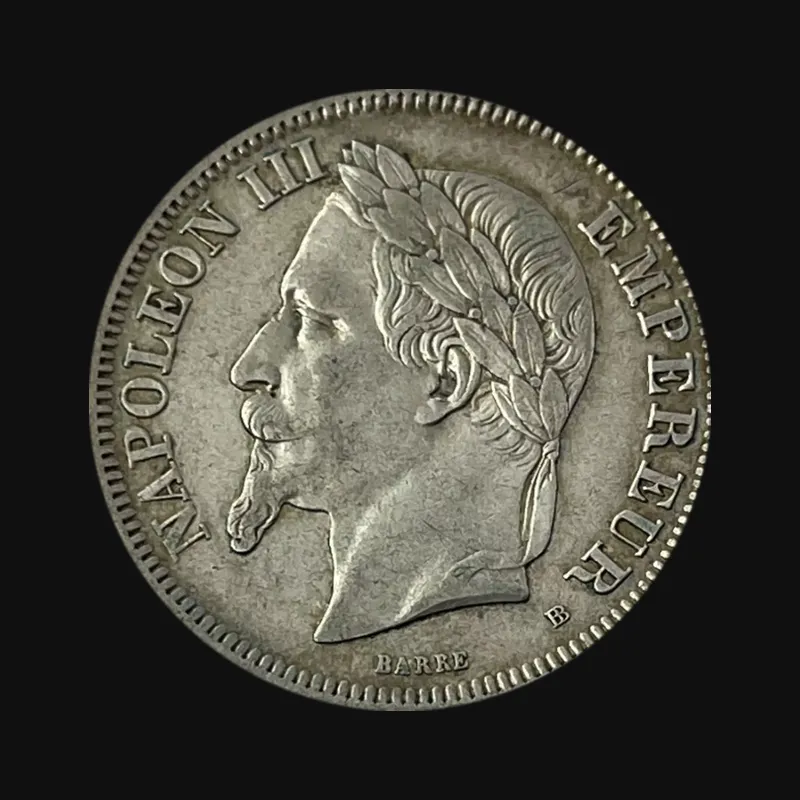
Obverse
Profile of Napoleon III facing left, signed BARRE below the neck, with the legend “NAPOLEON III EMPEREUR” between two small privy marks. Bare head from 1853 to 1863; laureate head, with a ribbon falling down the nape, from 1864 onwards.
Written by the Maison Or & Bijoux Le Havre team · updated
| Country | France |
|---|---|
| Metal | Silver, 900‰ fine (bare head), then 835‰ (laureate head) |
| Weight and diameter | 20c: 1 g, 15 mm (16 mm for the large module of 1867-1868); 50c: 2.5 g, 18 mm; 1 F: 5 g, 23 mm; 2 F: 10 g, 27 mm |
| Fine silver in the 2 francs | 9 g (bare head); 8.35 g (laureate head) |
| Years struck | Bare head 1853-1863 (2 F only until 1859); laureate head 1864-1869 (50c), 1864-1868 (20c), 1866-1870 (1 F and 2 F) |
| Mints | A (Paris), BB (Strasbourg), D (Lyon, 1856 only), K (Bordeaux, laureate heads from 1864 to 1867); none struck at Rouen (B) |
| Total mintage | About 71.5 million bare heads; about 189 million laureate 50c, 1 F and 2 F, plus the laureate 20c (full figure not recorded) |
| Edge | Reeded |
| References | Le Franc F.148 to F.150 (20c), F.187 and F.188 (50c), F.214 and F.215 (1 F), F.262 and F.263 (2 F) |
Four small silver coins carried everyday change under the Second Empire: 20 centimes, 50 centimes, 1 franc and 2 francs. The emperor's profile facing left and the legend “NAPOLEON III EMPEREUR” make them easy to spot. They tend to turn up by the handful, since more than 260 million were struck between 1853 and 1870, and one detail is enough to sort them: a bare head or a head wearing a laurel wreath.
Profile of Napoleon III facing left, signed BARRE below the neck, with the legend “NAPOLEON III EMPEREUR” between two small privy marks. Bare head from 1853 to 1863; laureate head, with a ribbon falling down the nape, from 1864 onwards.
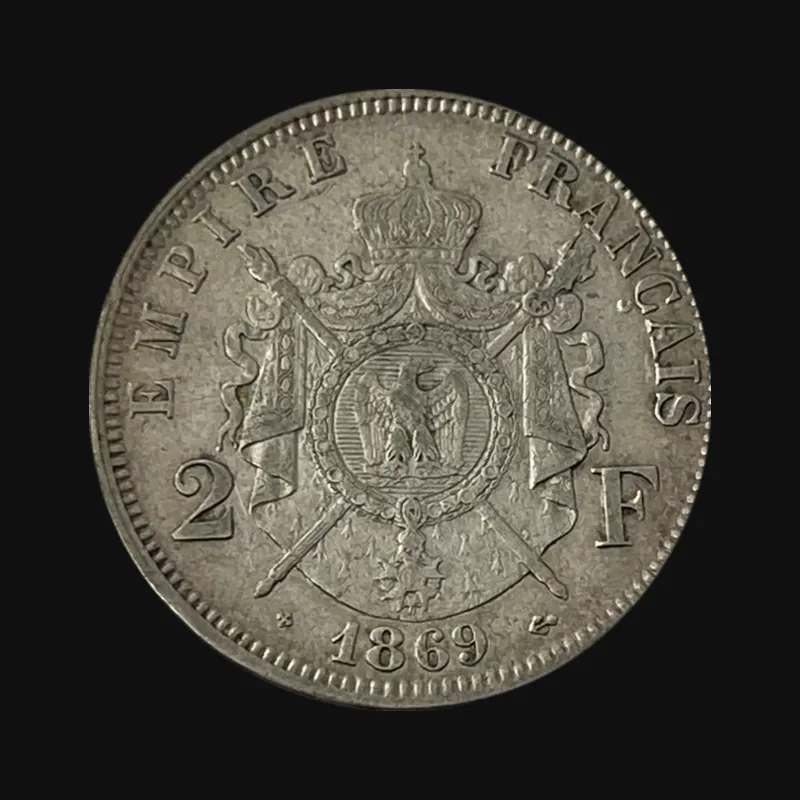
Bare head: the denomination (“20 CENT.”, “50 CENT.”, “1 FRANC”, “2 FRANCS”) and the year inside a wreath of two laurel branches tied at the bottom, the mint mark below the bow, legend “EMPIRE FRANÇAIS”. Laureate head: on the 20 and 50 centimes, the denomination, year and mint mark below an imperial crown; on the 1 and 2 francs, a shield bearing an eagle on a thunderbolt, inside the collar of the Legion of Honour, set on a mantle (crowned on the 2 francs), with “1 F” or “2 F” either side.
Start with the “Coin” column, then the year and the letter. The large Paris and Strasbourg issues are the everyday coins; the lines under 150,000 pieces are the ones collectors look for. The 1863 bare heads and the 1858 and 1859 2 francs are scarce because the melting of the 900‰ coins wiped out much of what had been struck.
| Year | Coin | Mint | Mintage | Remarks |
|---|---|---|---|---|
| 1853 | 2 F | A | 48,968 | First year of the 2 francs |
| 1853 | 50c | A | 153,830 | First year, small mintage |
| 1856 | 20c | BB | 13,342 | Smallest mintage of the whole series |
| 1856 | 2 F | D | 288,758 | Lyon struck in this year only |
| 1856 | 2 F | BB | 693,369 | Normal or small BB |
| 1858 | 1 F | A | 5,606,916 | Common year |
| 1858 | 2 F | A | 1,288 | Very rare |
| 1859 | 2 F | A | 894 | Last bare-head 2 francs; 886 according to another source |
| 1860 | 20c | A | 6,536,391 | Includes the 1860 over 1850 variety |
| 1860 | 50c | BB | 2,917,472 | Bee or trefoil cross privy mark |
| 1862 | 20c | A | 53,926 | Small mintage |
| 1863 | 1 F | A | 41,102 | Last bare head, few survive |
| 1863 | 1 F | BB | 54,173 | Same story |
| 1863 | 50c | BB | 137,011 | Same story |
| 1864 | 50c | A | 7,597,756 | First laureate head, already 835‰ |
| 1864 | 50c | K | 1,827,936 | Bordeaux joins the series |
| 1866 | 2 F | A | 3,225,798 | First laureate 2 francs |
| 1866 | 2 F | K | 437,055 | Smallest mintage of the laureate 2 francs |
| 1867 | 50c | A | 14,528,438 | Largest year for the 50 centimes |
| 1867 | 20c | BB | 3,114,264 | Large module, 16 mm |
| 1868 | 1 F | A | 14,942,298 | Largest mintage of the laureate 1 franc |
| 1868 | 2 F | BB | 733,227 | Small Strasbourg mintage |
| 1869 | 50c | BB | 1,800,000 | Last year of the 50 centimes |
| 1870 | 1 F | BB | 1,991,998 | End of the type |
| 1870 | 2 F | A | 3,187,168 | End of the type |
Mintages from the BDOR tables, cross-checked for several lines against Coinvarieties (2 F 1859 A, 1866 A and K), CGB (50c 1867 BB, 20c 1867 BB) and Numista (1 F 1867); list of combinations from Le Franc. Each figure covers every variety of that year and mint. The mintage of the 50c 1868 BB is not known (n/a). Discrepancies noted: 886 or 894 for the 2 F 1859 A, 703,812 (CGB) or 704,356 (BDOR) for the 20c 1858 A.
These coins were struck in two silver standards, and the portrait tells you which. Bare head: 900 parts per thousand, like the 5-franc écus. Laureate head: 835. There is no hallmark or fineness figure on the coin; the change of design was there precisely to keep the two series apart.
The reverse confirms it. Bare heads carry their denomination inside a laurel wreath. Laureate 20 and 50 centimes put it beneath an imperial crown, while the 1 and 2 francs show an eagle shield on a mantle. If a coin is too worn to judge the profile, look at the reverse first.
The switch came in two stages. The law of 25 May 1864 lowered the 20 and 50 centimes to 835‰, so every laureate head of those two coins, from 1864 on, is at the new standard. The 1 and 2 francs followed after the Latin Monetary Union convention, signed on 23 December 1865 with Belgium, Italy and Switzerland: their laureate head only appears in 1866. On a 2 francs the difference comes to 9 g of fine silver against 8.35 g, for the same 10 g coin.
The lower standard had a purpose: a coin holding slightly less metal than its face amount no longer gets melted down or carried abroad. The older, silver-richer bare heads were withdrawn at the end of the 1860s.
The mint mark is on the reverse: below the bow of the wreath on the bare head, below the year on the laureate head. Paris (A) and Strasbourg (BB) struck in almost every year. Lyon (D) appears only in 1856, on all four coins. Bordeaux (K) struck laureate heads only, from 1864 to 1867. The mints guide covers all these letters.
Unlike the gold coins, the two small privy marks sit on the obverse, either side of the legend. They change with the chief engraver and with the director of each mint: dog's head, hand, anchor, a lion for Lyon, a bee or trefoil cross for Strasbourg. In 1855 and 1856 several combinations exist for the same date.
Three groups of dates deserve attention. First the bare-head 2 francs: 894 pieces in 1859, 1,288 in 1858, under 50,000 in 1853. Then the last bare heads of 1862 and 1863, struck in small numbers and partly melted after the reform. Finally a few isolated pairings, such as the 20 centimes 1856 BB, the 2 francs 1856 D or the 2 francs 1866 K. The 1860 over 1850 varieties, with the 6 re-engraved over a 5, exist for the 20 centimes, 50 centimes and 1 franc, at Paris and Strasbourg.
Latin Monetary Union coins. Belgium, Switzerland, Italy and later Greece struck 50 centimes, 1 and 2 francs (or lire, or drachmai) to the same weight and diameter. They passed in France on equal terms with French coins and turn up in the same batches. Read the legend: a portrait of Leopold II or Victor Emmanuel II is not Napoleon III.
Patterns and “large heads”. In 1853, pattern pieces with a bigger head were struck for the 20 centimes, 50 centimes and 1 franc; they are catalogued separately (F.147, F.186, F.213). Other plain-edge patterns, and gold proofs dated 1854, only appear in specialist sales.
Counterfeits. Contemporary forgeries of the laureate 2 francs are reported. A forgery usually gives itself away by being too light, a dull ring, soft relief or uneven reeding. Check the weight to a hundredth of a gram (10 g for a 2 francs, 5 g for a 1 franc, slightly less after wear) and the diameter. A scarce date, above all a 2 francs of 1858 or 1859, also calls for a look at the last digit under a loupe to rule out an altered date. The guide to counterfeit coins sets out these checks.
These coins circulated hard, often until the First World War. Most are now in Fine to Very Fine condition, and wear shows quickly on such a small module.
On the obverse, look at the hair above the ear and the goatee. On the bare head the locks merge first into a smooth surface; on the laureate head the veins of the leaves go before the wreath blends into the hair. The ribbon on the nape stays legible longer.
On the reverse, fine details give way before the lettering: veins of the laurel leaves on the bare heads, pearls and crossbars of the imperial crown on the 20 and 50 centimes, the eagle's feathers and the links of the collar on the 1 and 2 francs. A coin that still grades Extremely Fine keeps those links distinct.
On the 20 centimes, which weighs a single gram, the mint mark and privy marks can fade before the rest: read them with a ×10 loupe before you sort the coin. A grey or golden toning is normal; bright white silver on a worn coin almost always means cleaning, which leaves fine scratches. See the guides to grading and cleaning, and the silver coins page.
No Napoleon III small silver coin carries the Rouen mint mark B: the Le Franc catalogue and the mintage tables list only Paris, Strasbourg, Lyon and Bordeaux for these four coins. Under the Second Empire the Normandy mint struck only the new bronze coinage, dated 1853 to 1857, before closing in 1858, before the laureate head even existed. The 50 centimes and 1 franc pieces found in Le Havre or elsewhere in Normandy therefore come from other mints, most often Paris. The story of the mint is told on the Rouen mint page.
Look at the portrait: bare head, 900‰; laureate head, 835‰. On the reverse, the laurel wreath goes with the bare head and the eagle shield on a mantle with the laureate head. No fineness figure is engraved on the coin.
K is the Bordeaux mint. On these coins it appears only on laureate heads dated 1864 to 1867. The 2 francs 1866 K, with 437,055 pieces, is one of the small mintages of the series.
Few were struck, and the 1864 reform led to the 900‰ coins being withdrawn and melted. Many pieces from those final years disappeared in the process.
First separate the French coins from the Latin Monetary Union ones, then the bare heads from the laureate heads. Then note the year and letter of each coin. A numismatist can look over the batch during a free valuation.