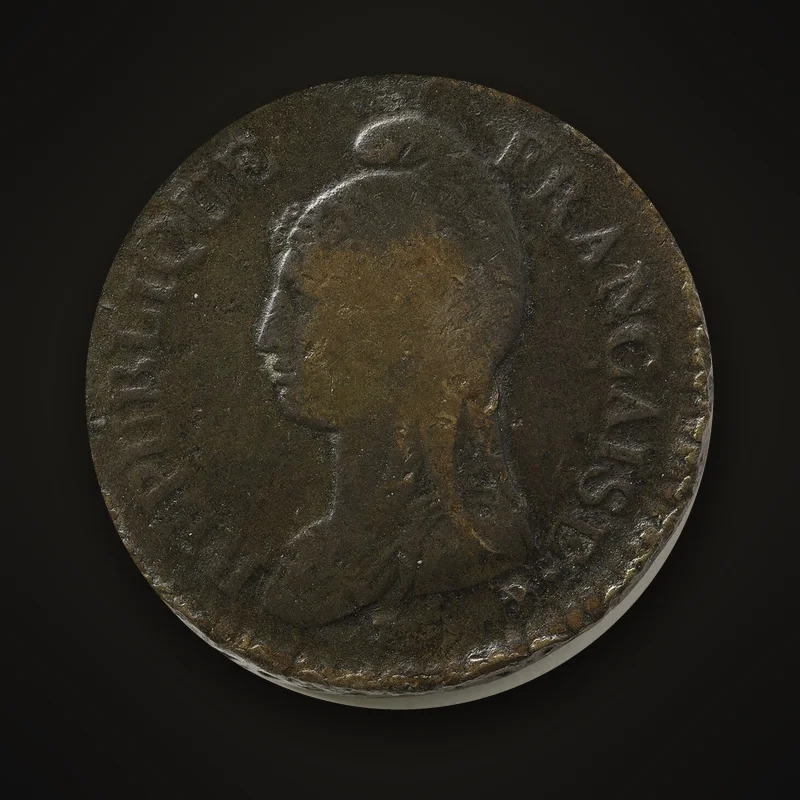
Obverse
Draped bust of the Republic facing left, with long hair and a Phrygian cap. Circular legend: “REPUBLIQUE FRANÇAISE”. The name “Dupré” is written in cursive script below the bust.
Written by the Maison Or & Bijoux Le Havre team · updated
| Country | France |
|---|---|
| Metal | Copper |
| 1 centime | 2 g, 18 mm, Year 6 to Year 8, Paris only |
| 5 centimes | 5 g and 23 mm (small module, Years 4-5), then 10 g and 28 mm (large module, Years 5-9) |
| Décime | 10 g (small module, Years 4-5), then 20 g and 32 mm (large module, Years 5-9) |
| 2 décimes | 20 g, 32 mm, Years 4 and 5, then dropped |
| Mints | A (Paris), AA (Metz), B (Rouen), BB, D (Lyon), G (Geneva), I (Limoges), K (Bordeaux), R (Orléans), T (Nantes), W (Lille), depending on denomination and year |
| Engraver | Augustin Dupré |
| Edge | Plain (1 centime) or chevron-reeded (5 centimes, décime) |
| References | Le Franc F.100 (1 centime), F.113 to F.115 (5 centimes), F.126 to F.129 (décime), F.145 (2 décimes); 1848-1851 revival of the centime: F.101 |
These are the first copper coins of the decimal system, struck under the Directory and then the Consulate. You know them by the head of the Republic in a Phrygian cap, the legend “REPUBLIQUE FRANÇAISE” and above all by a date that is not a calendar year: “L'AN 5”, “L'AN 8”. Struck in tens of millions and handled for half a century, they turn up often in old drawers, almost always worn.
Draped bust of the Republic facing left, with long hair and a Phrygian cap. Circular legend: “REPUBLIQUE FRANÇAISE”. The name “Dupré” is written in cursive script below the bust.
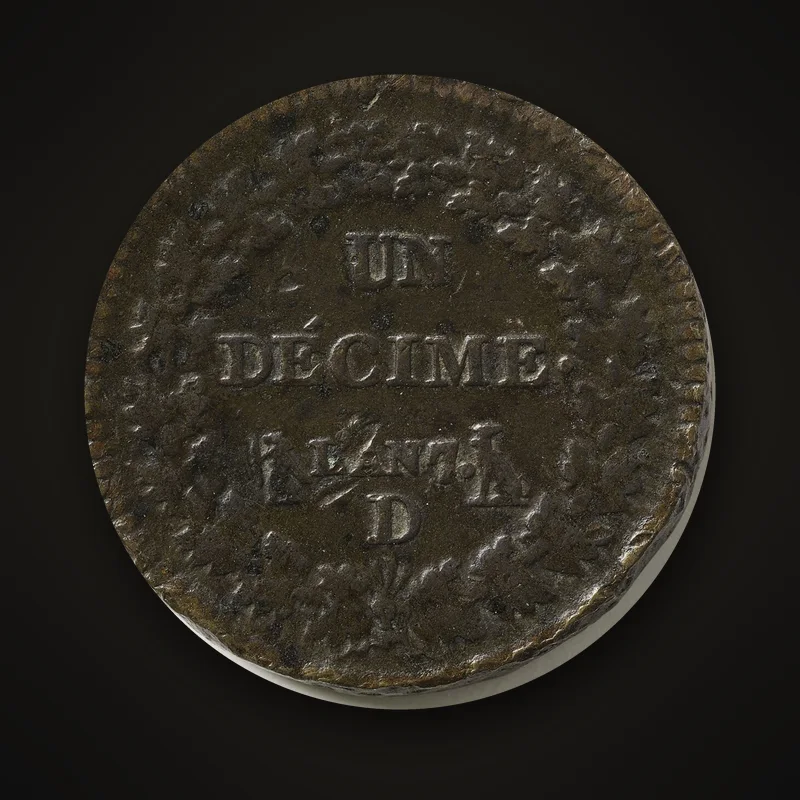
Décime and 5 centimes: the denomination on two lines, “UN / DÉCIME” or “CINQ / CENTIMES”, above “L'AN 5” (or another year) followed by the mint letter, all within a closed wreath of two oak branches tied with a ribbon. Two small symbols, the privy marks, accompany the inscription. 1 centime: “UN / CENTIME”, the year and the letter A, with no wreath, inside a beaded border.
The table follows the order of issue: first the light pieces of Year 4, then the overstrikes, and finally the large modules of Years 5 to 9. The dates to look out for are those of the small mints (Geneva, Bordeaux, Rouen), overstrikes where the old legend can still be read, and altered dates such as “AN 7/5”.
| Coin | Year | Mint | Mintage | Remarks |
|---|---|---|---|---|
| 2 décimes | Year 4 | A | n/a | Host coin for the Year 5 overstruck décimes |
| Décime, small module | Year 4 | A | 3,617,156 | 10 g piece, poorly received |
| Décime, small module | Year 4 | K | n/a | Bordeaux, scarce |
| Décime on altered 2 décimes | Year 4 | A | 537,500 | Figure 2 filed off, word UN punched in |
| 5 centimes, small module | Year 4 | A | 11,589,079 | 5 g piece |
| 5 centimes, small module | Year 4 | T | n/a | Nantes |
| Décime overstruck on 2 décimes | Year 5 | T | 84,941 | Traces of the earlier legend |
| Décime overstruck on 2 décimes | Year 5 | B | n/a | Rouen |
| 5 centimes overstruck on décime | Year 5 | I | 654,199 | Limoges |
| 5 centimes overstruck on décime | Year 5 | B | n/a | Rouen |
| Décime, large module | Year 5 | B | 2,040,472 | Rouen, not common |
| 5 centimes, large module | Year 5 | B | n/a | Rouen, several varieties |
| 1 centime | Year 6 | A | n/a | First date of the centime |
| 1 centime | Year 7/6 | A | n/a | Altered date |
| Décime, large module | Year 7/5 | A/B | n/a | A cut over a B |
| 5 centimes, large module | Year 8 | A | 20,598,666 | The most frequent date |
| 5 centimes, large module | Year 8 | G | n/a | Geneva, then French |
| Décime, large module | Year 8 | G | n/a | Geneva |
| Décime, large module | Year 9 | I | n/a | Last year of the type |
| 1 centime (revival) | 1848 to 1851 | A | n/a | Same design, Gregorian date |
Mints and varieties from Le Franc (F.100, F.101, F.113 to F.115, F.126 to F.129, F.145). Mintages from Coinvarieties, except the Nantes and Limoges overstrikes, taken from CGB listings; each figure rests on a single source. For the 1 centime, Coinvarieties gives a total of 48,778,486 pieces for Years 6 to 8, with no breakdown by year. Figures for 1848-1851 differ too widely between sources to be used.
These coins carry no Gregorian year but a year number from the Republican calendar. Year 1 began on 22 September 1792, the day the Republic was proclaimed, and each following year started around 22 or 23 September. A coin dated “L'AN 5” was therefore struck between autumn 1796 and summer 1797. A simple rule: add 1791 to the number to get the year in which it ended. Year 4 is 1795-1796, Year 8 is 1799-1800, Year 9 is 1800-1801.
The letter after the date shows the mint. Paris (A) struck the bulk, but about ten mints took part: Metz (AA), Rouen (B), Lyon (D), Geneva (G), Limoges (I), Bordeaux (K), Orléans (R), Nantes (T), Lille (W), plus BB. Geneva, annexed to France in 1798, appears only in Years 8 and 9. The guide to French mints places each of these letters.
On many pieces the date or the letter was altered on the die: “AN 7/5” means a 7 was cut over a 5. This is explained by dies being reused from one year to the next, and sometimes passed between mints, which gives double letters such as A/B or W/A.
The first series, dated Year 4, was light: 5 g for the 5 centimes, 10 g for the décime, 20 g for the 2 décimes. The public would not take it. From Year 5 the weight of the 5 centimes (10 g) and of the décime (20 g) was doubled, and the 2 décimes was dropped.
Rather than melt the old stock, the mints struck it again. A light 10 g décime weighed the same as a new 5 centimes, so it went back under the 5 centimes dies. A 20 g piece of 2 décimes matched a new décime and became one. The Le Franc catalogue lists these separately as “refrappage” (F.114 for the 5 centimes, F.128 for the décime). On a well-struck example you can still read fragments of the old legend under the new one: an S from “DÉCIMES” above the word “DÉCIME”, for instance.
Before these overstrikes, Paris and Limoges had tried a quicker fix: filing off the figure 2 on the 2 décimes and punching the word “UN” in its place (F.127). The result shows a flattened patch and incuse letters.
The 1 centime avoided all this. It first appears in Year 6, at Paris only, and keeps the same 2 g weight until Year 8.
Le Franc records over one hundred and fifty varieties of the large-module 5 centimes alone, and more than seventy for the décime. They come from altered dates, re-cut letters, the size of the figures and small engraving errors. Some dies read “CNIQ” instead of “CINQ”. On the Year 7 centime, collectors separate a large 7, a normal 7 and a small 7.
These coins stayed in circulation until the 1850s, so the great majority grade Good or Fine. As a rule, on the obverse, wear first reaches the hair showing beneath the cap, then the rim of the cap and the folds of drapery on the shoulder. On the reverse, the veins of the oak leaves and the loops of the ribbon go before the lettering.
Copper picks up green or black spots. Do not scrape anything or use any product: bare metal never regains its patina, and a collector spots a rubbed coin at once. Original red colour very rarely survives. See the guides to grading and to cleaning.
The 1 centime of 1848 to 1851. The Second Republic brought back Dupré's design for a new 2 g centime struck at Paris. This time the date is Gregorian, “1848” to “1851”. No centimes at all had been struck between Year 8 and 1848.
The Antwerp siege pieces. In 1814 the besieged city, held by Carnot, produced emergency pieces of 5 and 10 centimes. They bear a monogram inside a wreath, not the head of the Republic.
Satirical pieces. Some Dupré décimes were reworked with punches or engraving to carry political slogans or figures. They are not official varieties.
The bronzes of 1852 to 1857. Napoleon III's 5 and 10 centimes, known as the “dog” coins, replaced these coppers. They carry an emperor's portrait: see the page on Napoleon III bronzes. For fakes, the guide to counterfeit coins sets out the basic checks: weight, diameter, edge.
The law of 28 Thermidor Year III (15 August 1795) made the franc the monetary unit of France and divided it into décimes and centimes. The first copper coins were entrusted to Augustin Dupré, who also designed the Hercules of the 5 francs silver écus.
The first striking, in Year 4, met with public refusal. Paper money was collapsing at the time: the Directory abandoned the assignat in 1796, then the territorial mandates in 1797. The series resumed in Year 5 with coins twice as heavy, struck in large numbers until Year 9 by most of the mints.
They then stayed in people's pockets for half a century, with no new issues of these denominations under the Consulate and the Empire. The recoinage of old copper launched early in the Second Empire replaced them with bronze pieces. The 1848 centime, also in copper, disappeared with this recoinage. The period is covered on the page about 19th-century French coins.
The Rouen mint did strike coins of this type, but only in Year 5, under the letter B: large-module décimes and 5 centimes, as well as décimes overstruck on 2 décimes and 5 centimes overstruck on décimes. Coinvarieties records 2,040,472 décimes of Year 5 B. Rouen struck neither the 1 centime, which was reserved for Paris, nor the light pieces of Year 4. Le Franc also records an A cut over a B on 5 centimes dated AN 7/5 and AN 8/5, and on décimes dated AN 7/5. The story of the Normandy mint is told on the Rouen mint page.
Add 1791 to the number to get the year in which it ended, and take away 1 for the year in which it began. Year 5 runs from September 1796 to September 1797, Year 8 from September 1799 to September 1800.
It is most likely an overstrike: an old 2 décimes struck again as a décime in Year 5. Remains of “DÉCIMES” or of another date identify this type, which catalogues list separately.
No. It is the revival of Dupré's design under the Second Republic, struck at Paris from 1848 to 1851. Revolutionary centimes carry a Republican date, Year 6 to Year 8.
It stands for the Rouen mint. On this type Rouen worked only in Year 5, on the décime and the 5 centimes. A numismatist can confirm the reading during a free appraisal.