Where to start
Put the coin on an accurate kitchen scale: a genuine silver 100 francs reads 15 g. Then look at the design. The Panthéon, recognisable by its dome, calls for a careful reading of the date, since a few years were produced in only a few thousand pieces. A commemorative is identified by its subject, which is enough to date it because each theme matches a single year.
Finally, look at the surface. A coin with a mirror field, or one still in a case with its certificate, belongs to a collector finish: do not take it out of its packaging.
Common mix-ups
- The 100 francs Cochet (1954-1958): same face value, but it is an old-franc coin with no silver. It is covered with the Guiraud and Cochet francs.
- The 10 and 50 francs Hercule: also 900‰ silver, but 25 g and 30 g, and dated before 1982.
- The 100 francs issued in sets by the Paris Mint, in another format or in gold: the Marie Curie struck in gold in 5,000 pieces, or the 1993 Louvre, issued as 20,000 in silver.
- Trials: engraved with the word ESSAI and made, for each subject, in quantities between a few hundred and a few thousand.
Engraver's marks and premium editions
Chief Engraver between 1974 and 1994, Émile Rousseau signed the coins with a dolphin. His successor Pierre Rodier chose the bee, seen on the Panthéon from 1995. For the same design, the mark therefore shows the period.
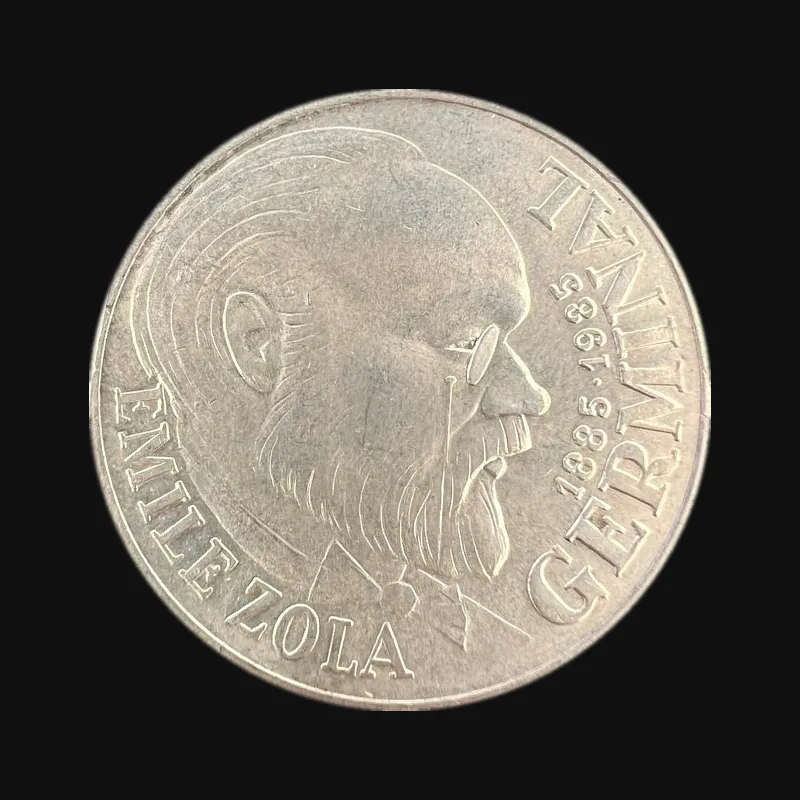
The Paris Mint also kept a few subjects for higher qualities, in small runs: proof for 1,000 Marie Curie and 5,000 Zola, uncirculated for 50,000 Zola, brilliant uncirculated for 25,000 La Fayette. Proof Panthéon coins cover the years 1991 to 2001.
What damages these coins
Circulation wear is rare: these coins changed hands little. The damage comes from storage. The wide smooth field scratches as soon as it rubs against another coin; the smooth edge shows knocks; the silver darkens or turns iridescent in old sachets and rolls. On the Panthéon, look first at the top of the dome and the pediment; on portraits, the cheek, nose and hair.
No cleaning: even gentle, it leaves fine marks. Read cleaning a coin and grades of condition (in French). Against copies, remember three signals: weight under 15 g, reaction to a magnet, soft relief or a pitted surface; see spotting a fake coin (in French).
Twenty years of silver in the franc
The creation of the silver 100 francs in 1982 broke with the rest of the coinage, struck in non-precious metals. Jean-Claude Dieudonné's Panthéon design served as the standard type. Hoarded almost at once, the coin saw its mintage melt: only 81,000 Panthéon coins in 1987.
From 1984 to 1997, a different commemorative came out each year. The subjects mix people, republican values and historic anniversaries. Until 1992, mintages stayed near 4 to 5 million; they then dropped below 2 million, and the final Malraux stayed under 500,000.
The last Panthéon coins, up to 2001, were meant for sets. With the euro, the coin lost its legal tender status in 2002; the Banque de France stopped exchanging it after February 2005. More broadly: new franc coins (in French).