From 1854 to 1904, an on-and-off denomination
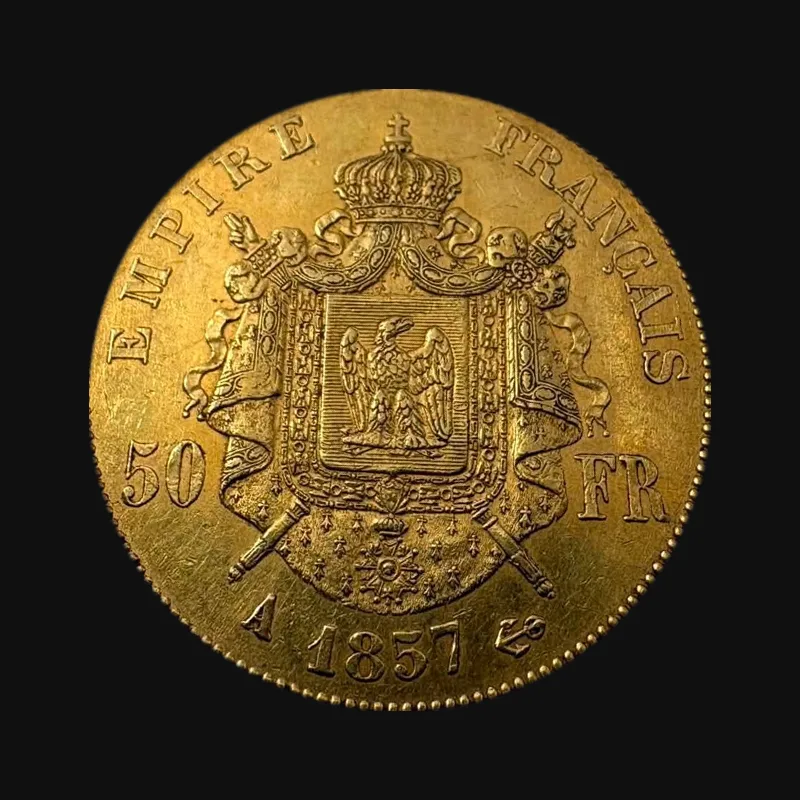
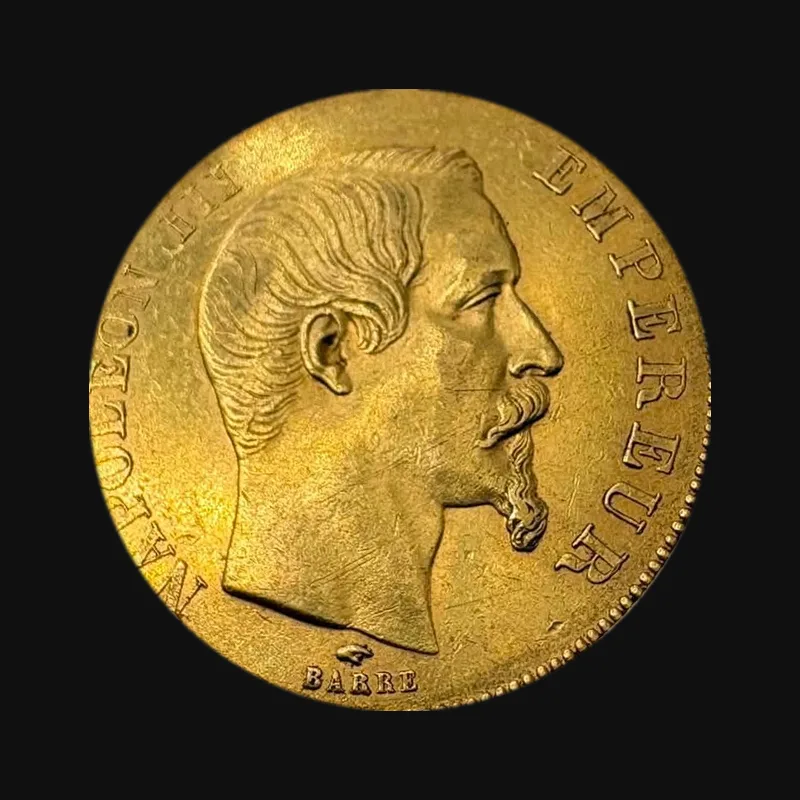
A decree of 12 December 1854, mentioned by BDOR and Abacor, established the 50 francs gold. Paris and the BB mint started striking the following year, with the emperor's bare portrait. The laurel appeared in 1862 on all gold coins of the reign, and the 50 francs followed suit until it stopped in 1868.
Fewer than a million imperial coins in fourteen years: by Second Empire standards, that is little. After 1870, the Republic revived the value only in fits and starts with the Genius: 1878 and 1889, two Universal Exhibition years, then 1887, 1896, 1900 and finally 1904, the only sizeable issue. The period is put in context on the page about 19th-century coins (in French).
Obverse, reverse, date: the method
On the obverse, tell three figures apart: the emperor without a wreath (1855-1859), the laureate emperor (1862-1868), the winged Genius (1878-1904).
On the reverse, the letter at the foot of the imperial shield, near the date, gives the mint: A for Paris, BB for the second mint selected. The Genius was never struck anywhere but Paris. For the other letters of the period, see the mint guide (in French).
For the date, keep the gaps in mind: no 50 francs in 1860 or 1861, none between 1869 and 1877, no BB in 1856, 1857, 1864 or 1865, no Paris in 1863. The Genius is limited to 1878, 1887, 1889, 1896, 1900 and 1904.
Where the 50 francs sits among gold coins
Diameter is the best guide. The Napoleon III 5 francs gold, about 17 mm, and the Napoleon III 20 francs, 21 mm for 6.45 g, carry the same portraits. The 100 francs gold (35 mm, 32.26 g, reading “100 FRS”) also exists with Napoleon III and with the Genius. At 28 mm, the 50 francs sits between them.
Two other coins cause confusion through their name or design: the very common Genius 20 francs, which shrinks the scene of the Republican 50 francs, and the Hercules 50 francs (1974-1980), a large 41 mm silver coin. Before 1855, the 40 francs gold, 26 mm across, was the top of the range; its last striking dates from Louis-Philippe.
Patterns, burnished flans and fakes
Coins out of the ordinary are above all presentation strikes: plain edge and burnished flan in Paris in 1855, laureate patterns with a plain edge in 1862 and 1868, then, for the Genius, 30 burnished flans and two patterns in 1878 (one with “grande écriture”, large lettering) and the 100 coins of 1889. Abacor draws attention to a counting problem: part of the mintage credited to 1866 A is said to bear the date 1865, which casts doubt on the 1865 figure.
Fakes follow scarcity: the 1887 and 1900 Genius coins are the most exposed, whether as copies in gold, pieces in gilt metal or an 1904 whose 4 has been turned into a 0. Basic checks: 16.13 g on the scale, 28 mm with the calliper, a sharp and even edge inscription, fine detail on the face or wings and, under a loupe, a last date digit with no sign of reworking. The fake coin guide (in French) goes further.
Assessing the condition of a 50 francs
High points wear in the same order as on a 20 francs, with slightly more margin thanks to the 28 mm module. Bare-headed Napoleon III: hair above the ear, cheekbone. Laureate Napoleon III: the leaves of the wreath, which soon lose their veins. Imperial reverse: eagle, thunderbolt, collar, all finely detailed.
The Genius shows wear first on the torso and shoulder, next on the wings and the rooster; on the other face, the veins of the wreath are the first to go.
A coin this heavy gets marked by contact with others: knocks on the edge, hits in the fields, which enter the grade just as wear does. Do not clean it under any circumstances. Pointers (in French): grading and why to avoid cleaning.