Skip to content
France

Chambers of Commerce “Bon pour” 50 centimes, 1 franc and 2 francs

France · 1920-1929

Written by the Maison Or & Bijoux Le Havre team · updated

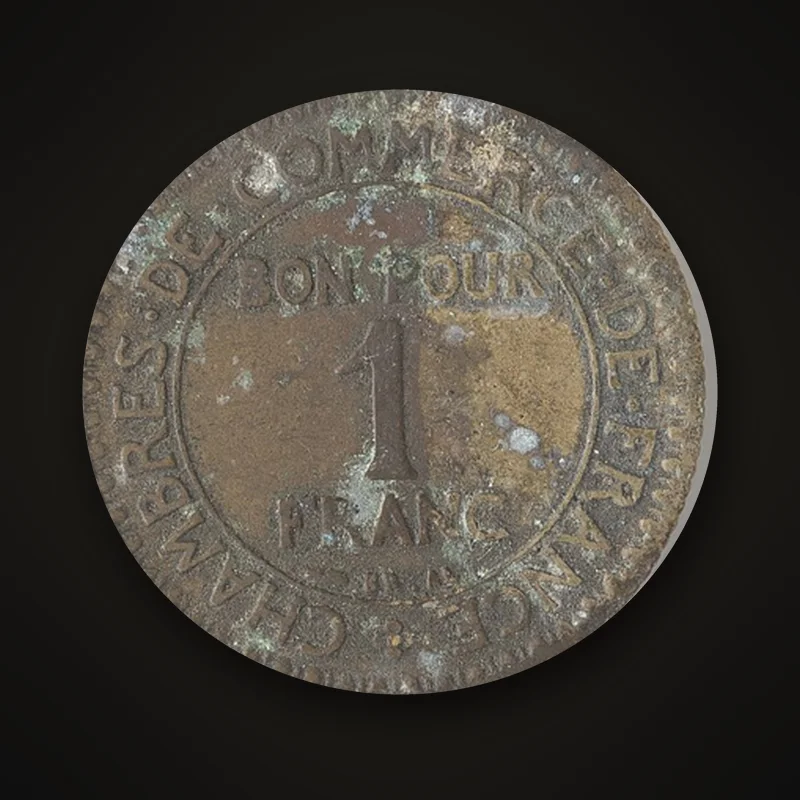
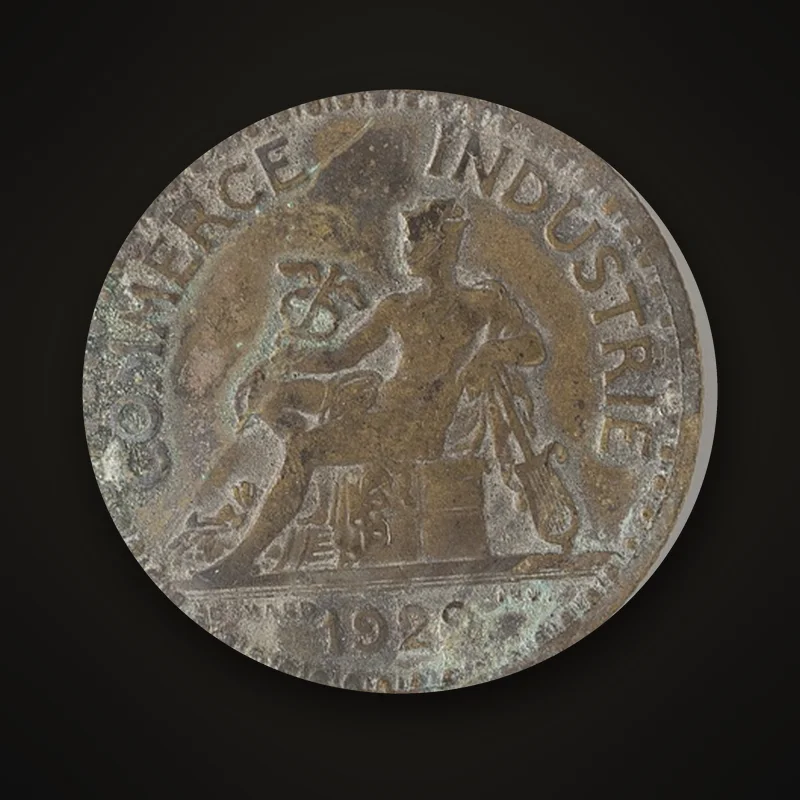
1922 Chambers of Commerce 1 franc in aluminium bronze, obverse with Mercury seated and the legend COMMERCE INDUSTRIE1922 Chambers of Commerce 1 franc, reverse reading BON POUR 1 FRANC
Photos: Paris Musées / Musée Carnavalet, CC0, via Wikimedia Commons, cut out on a black background.
Specifications
CountryFrance
MetalAluminium bronze (about 91% copper, 9% aluminium)
Weight2 g (50 centimes), 4 g (1 franc), 8 g (2 francs)
Diameter18 mm (50 centimes), 23 mm (1 franc), 27 mm (2 francs)
Years struck1920 to 1927 for the 1 and 2 francs; 1920 to 1929 for the 50 centimes
MintParis, no mint mark
EngraverJoseph-François Domard (“DOMARD INV.”)
Demonetised5 August 1949
ReferencesLe Franc F.191 (50 c), F.218 (1 F), F.267 (2 F); KM 884, 876 and 877

These brassy-yellow coins, with a seated Mercury and the words “COMMERCE INDUSTRIE”, took the place of France's small silver change in the early 1920s. The reverse does not say “République française” but “Chambres de commerce de France, bon pour”: they are emergency money, struck by the hundred million. That is why they turn up so often in family boxes, nearly always in common dates.

Identification

Chambers of Commerce “Bon pour” 50 centimes, 1 franc and 2 francs: how to recognise it

1922 Chambers of Commerce 1 franc in aluminium bronze, obverse with Mercury seated and the legend COMMERCE INDUSTRIE

Obverse

Mercury, god of trade, seated left on a bale of goods and wearing the winged petasos. He holds a caduceus and rests a hand on an ancient rudder, with a cornucopia behind him. Legend: “COMMERCE INDUSTRIE”. In the exergue, the date sits between “DOMARD” and “INV.”.

1922 Chambers of Commerce 1 franc, reverse reading BON POUR 1 FRANC

Reverse

Circular legend “CHAMBRES DE COMMERCE DE FRANCE”. In the field, on three lines: “BON POUR”, the figure, then “FRANCS” (or “FRANC”, “CENTIMES”). Below, the cornucopia, privy mark of the Paris Mint (CGB calls it the mark of the Régie des monnaies), and “BR. AL.” for aluminium bronze. There is no mint mark: everything was struck in Paris.

Edge
Reeded on the 2 francs. For the 1 franc and 50 centimes, the catalogues consulted disagree (plain or reeded).
Engraver
Joseph-François Domard (1792-1858), medal engraver. Mercury is taken from one of his 19th-century designs, hence “INV.” (he devised it), even though he had been dead for more than sixty years.
Dates and mintages

Chambers of Commerce “Bon pour” 50 centimes, 1 franc and 2 francs: key dates

All three coins share the same calendar until 1927; after that only the 50 centimes carries on. Each year from 1922 to 1925 runs to tens of millions of pieces: those are the everyday dates. Take a closer look at the 1927 2 francs, the 1926 1 franc, the 1929 50 centimes and anything dated 1920.

Chambers of Commerce “Bon pour” 50 centimes, 1 franc and 2 francs: dates and mintages
YearCoinMintageRemarks
192050 centimesn/aPattern only (F.191/1)
19201 francAbout 590,000First year, small mintage; a separate pattern exists
19202 francs14,362,786 (1920 and 1921)Less common than later years; a separate pattern exists
192150 centimes8,691,867First circulating year; a 1921 pattern also exists
19211 franc54,571,959Common
192250 centimes86,225,994Common
19221 franc111,342,910Common
19222 francs29,462,887Common
192350 centimes119,583,707Largest mintage of the series
19231 franc140,137,683Largest 1 franc mintage
19232 francs43,960,369Largest 2 francs mintage
19242 francs29,631,410Common; figure disputed, see note
19251 franc36,522,732Common
19252 francs31,606,872Common
19261 franc1,579,575Scarcest 1 franc date
19262 francs2,962,351Uncommon
19271 franc11,815,745Final year, less common
19272 francs1,678,263Scarcest 2 francs date
192850 centimes10,329,430The 50 centimes continues alone
192950 centimes6,668,514Final year, smallest 50 centimes mintage

Mintages from Stash of Coins and Coinvarieties (which cites Gadoury), and for the 1920 1 franc from Numista (citing Le Franc); the 1926 2 francs is confirmed by CGB. Pattern numbering after Le Franc. Known discrepancies: Coinvarieties gives 29,931,000 for the 1924 2 francs, and repeats the 1922 figure for the 1921 1 franc. The 2 francs mintage is only published for 1920 and 1921 combined. Years missing from the table had ordinary mintages.

Why coins in the name of the Chambers of Commerce?

From August 1914, gold and then silver vanished from circulation as people kept them at home. Small change ran short for giving change at the market or paying a tram fare. The Ministry of Finance let chambers of commerce, towns and traders' associations put out their own notes and tokens, from a few centimes to a few francs. This was emergency money: paper, card or metal, in hundreds of different types.

After the war the franc had lost much of its purchasing power. A silver 2 francs held more metal than it could buy, and the silver Semeuse stopped being struck in 1920. Rather than launch a base-metal state coinage, which would have admitted that the franc had slipped, the authorities had the Paris Mint strike a single series in the name of all the chambers of commerce together. In law it was a redeemable voucher, hence the wording “bon pour”, meaning “good for”.

The coins stayed in use into the 1930s, alongside the Morlon types that replaced them from 1931, and were demonetised in 1949. They belong to the Third Republic coinage.

Dates to watch, patterns and piedforts

Sort first by date, which you read in the exergue below Mercury. On the 2 francs, 1927 is the date collectors look for, with fewer than 1.7 million struck; 1926 and 1920 follow. On the 1 franc, 1926 stands out with about 1.6 million, ahead of 1920 and 1927. On the 50 centimes, 1929 closes the series with the smallest mintage.

Patterns carry the word “ESSAI” in the field. Le Franc lists one for each of the three coins in 1920, and a second for the 50 centimes in 1921. Piedforts, struck on a much thicker blank than normal and dated 1920, are reported by some catalogues for the 50 centimes and 1 franc; Le Franc does not list them. None of these ever circulated, and they stay in specialist collections.

Otherwise, most pieces you will come across are dated 1921 to 1925. What sets one apart is its condition: a coin with crisp relief and its original colour is far harder to find than a worn, browned one. A numismatist can look over a batch during a free appraisal.

Varieties and fakes: what to check

The catalogues consulted record no major die varieties on these types: the distinctions are year, pattern and piedfort. So the thing to watch is the date. No such fake is described in the sources consulted, but a common coin with its last digit tooled to look like 1926 or 1927 remains possible. Compare the shape and alignment of the figures under a glass with an ordinary coin, and look for tool marks around the date.

Next, check weight and diameter: 8 g and 27 mm for the 2 francs, 4 g and 23 mm for the 1 franc, 2 g and 18 mm for the 50 centimes. A piece that is too light, too orange in tone or soft in relief deserves a second look.

At the time, the finance law of 29 April 1921 extended criminal protection against counterfeiting to emergency money. General methods are gathered in the guide to spotting a fake coin.

Grading this coin

Aluminium bronze leaves the press a bright yellow, close to brass. Over time it darkens to a bronze shade, sometimes with dark spots. A piece that has kept its original lustre is the exception.

On the obverse, wear hits Mercury's high points first: the knee, the shoulder, the wings of the hat. The caduceus and rudder then lose their sharpness, and finally the bale merges into the field. The tiny “DOMARD” and “INV.” go early, so they tell you at a glance whether a coin is heavily worn. On the reverse the large lettering holds up for a long time; look at the cornucopia and the “BR. AL.” instead.

Most pieces kept in families grade Fine or Very Fine. Do not rub them or use any product: the metal scratches and takes on an artificial colour that is spotted at once. See the guides to grading and to cleaning.

Not to be confused with

Local chamber notes and tokens. Each chamber of commerce could issue its own small notes, usually paper, in the name of a town or area. The “Bon pour” coins are different: one national type, in the name of the “Chambres de commerce de France”, struck in Paris.

The Morlon types. From 1931, 50 centimes, 1 franc and 2 francs pieces in the same metal show a head of Marianne and the words “République française”. Same colour, same size, but issued in the state's own name.

The silver Semeuse. The 50 centimes, 1 franc and 2 francs from before 1920 have a different design and metal. Colour alone separates them.

Colonial coins. Several territories received aluminium bronze coins at the same time or later; their legend always names the territory. See the page on French colonial coins.
In Le Havre

Chambers of Commerce “Bon pour” 50 centimes, 1 franc and 2 francs in Normandy

Like chambers all over France, the Le Havre Chamber of Commerce issued its own small-denomination notes during the war. Online catalogues record vouchers dated 1916 and 1917 in the name of the Le Havre Chamber of Commerce, including a two-franc voucher issued with the City of Le Havre. The “Bon pour” coins of 1920 to 1929, struck in Paris with no mint mark, took over from these local issues; none came from the Rouen mint, which had struck nothing since 1857.

Chambers of Commerce “Bon pour” 50 centimes, 1 franc and 2 francs: frequently asked questions

Are these real coins or tokens?

In law they are vouchers issued in the name of the chambers of commerce, hence “bon pour”. In practice they circulated like ordinary money, were struck by the Paris Mint and were not demonetised until 1949.

Which dates are most sought after?

The 1927 2 francs, the 1926 1 franc and the 1929 50 centimes, the smallest mintage in each series, along with pieces dated 1920. Patterns marked “ESSAI” and piedforts are a separate matter.

Why does a 1920s coin carry the name DOMARD?

Mercury is taken from a design by the engraver Joseph-François Domard, who died in 1858. “INV.” means he devised it: the design was reused, not created for these coins.

My coin is brown and spotted: should I clean it?

No. Aluminium bronze darkens naturally. Cleaning leaves scratches and an artificial colour that show straight away. Keep it as it is.

More coins
Sources